Setting the Saemangeum stage: Korea’s brilliant move
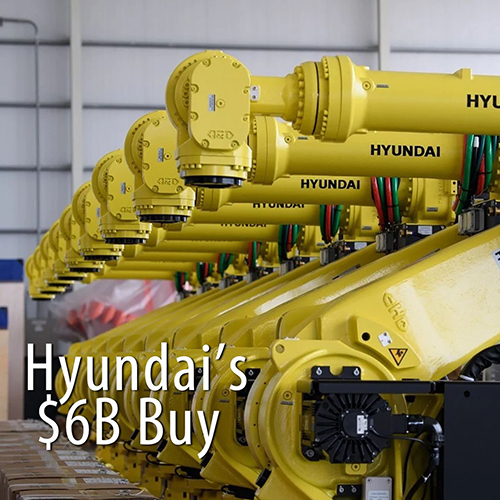
Last time we hooked up with Hyundai and Team Korea, they were throwing down $6 billion as Hyundai swooped into Waltham, MA in 2025, announcing that it would buy tens of thousands of Atlas humanoids from Boston Dynamics (80% of which it had acquired from SoftBank in 2021 for $880 million; and then in 2026 acquired the balance for $325 million). Before Hyundai swooped back to Korea, Robert Playter, CEO of Boston Dynamics, said about the Hyundai meetup: “This is not just about the U.S.—this is about creating the most advanced robotics ecosystem worldwide.”
Hyundai’s brilliant move was in acquiring Boston Dynamics prized, world-class humanoid robot, Atlas, as well as all of the company’s world-class IP. Hyundai polished its brilliant prize by putting up the cash to make an electric version of Atlas, which was part of the $6B swoop into Waltham in 2025. After which the new owners pulled off a Vulcan mind-meld between Boston Dynamics and Hyundai technical staff. Voilà! the resulting prize, minus the years of trial and error in R&D to develop its own humanoid. The perfect machine was born ready for installation as Korea’s prime humanoid for the 2026 announcement of the soon-to-be Saemangeum innovation and industrial zone.
See related: Hyundai swoops in on Boston Dynamics 2025
Twin ironies of the sale: 1. Atlas is the result of decades of seeing millions of dollars flow from DARPA, U.S. Army & Navy development contracts (a/k/a U.S. taxpayer dollars); 2. SoftBank owned Hyundai until 2021, and as a Japanese investor had a perfect opportunity to engage Japan and Japan’s massive industrial robotics ecosystem in worldclass humanoid robotics.
However, the Japanese were and are far from ready to build their own humanoid and its current industrial infrastructure is rooted in excellence in industrial arms and robot parts, and somewhat in elderbots. Korea, on the other hand, was ready to rock ‘n roll. In fact, sadly for Japan, it now has to resort to Chinese humanoids working in Japanese factories.
Splash down, Korea to “move some atoms”
Ever since the multi-million dollar Hyundai acquisition of 2021, the robotics world has been waiting for the other Korean shoe to drop. Now it has with a thunderous splash in western Korea’s Saemangeum (meaning, New Golden Land), which is an enormous, 150 square miles of tidal flat and marsh lands on the West Sea (Yellow Sea), about 12 miles from the city of Gusan. Originally, the Korean government previously sought to reclaim for agriculture (hence, the moniker: New Golden Land) as well as for some industry (see map).
Robotics/AI and a massive opportunity have pushed all that aside. New Golden Land is now slated to be a global mega-special zone for “Physical AI and Robotics.” And will sport some impressive signs that Korea’s is once again stepping up big time on its technology gas pedal (see Korean New Deal 2020). When built, the zone will be a sprawling, state-of-the-art AI, robotics, and hydrogen innovation hub.
The Saemangeum “Physical AI and Robotics” zone is more than a reclamation and buildout, it heralds Hyundai Motor Group evolving from a traditional automaker into a self-described “Smart Mobility Solution Provider“. That’s a vision of Hyundai where “vehicles operate similarly to smartphones, utilizing central computing architectures that allow continuous over-the-air (OTA) updates, cloud-managed battery systems, and tailored AI-driven digital services, like partnerships with Samsung SmartThings to meld vehicle software with smart home IoT.”
By developing what is being called the “Saemangeum AI Valley,” Hyundai Motor Group is attempting to control the entire vertical stack of physical AI—uniting NVIDIA’s (50,000 Blackwell GPUs) processing hardware, Boston Dynamics’ robotics expertise, and clean domestic energy infrastructure. The planned AI Data Center alone is projected to cost upwards of $4 billion, anchoring the critical need for compute for “physical AI”, autonomous driving, and advanced robotics.
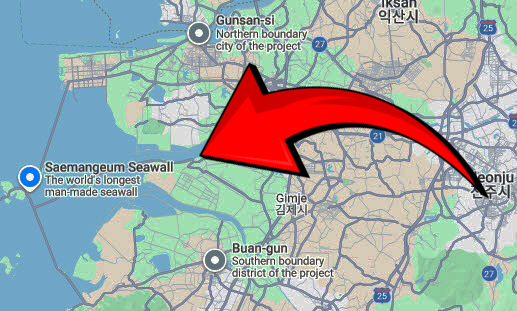
So what’s the deal with Korean robotics…specifically, Atlas?
When and if they pull it off, it will be truly monumental for Korea! First off, Hyundai is supercharging its initial investment in the robot makers from Waltham, creating a physical ecosystem where Boston Dynamics’ cutting-edge robotic expertise can be scaled, manufactured, and deployed at an unprecedented, world-changing level.
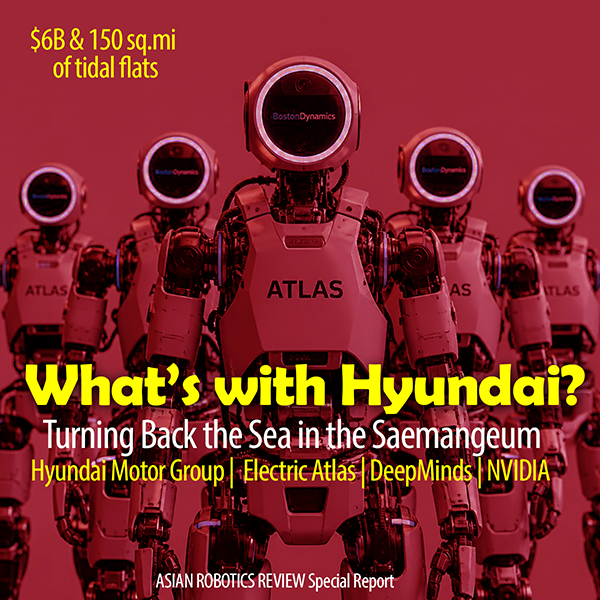
What began life as a U.S. taxpayer-financed, world-famous but bulky hydraulic humanoid, has now been transformed into the svelte, Hyundai-financed all-electric Atlas (see photo). Electric Atlas will become the hero of the Saemangeum, easily compete with China’s best, possibly be crowned Emperor of the East, and piss off the America that it let this magnificent machine slip away (worse steal than China bagging KUKA). The Koreans, who Asian Robotics Review tabbed The Quiet Giants of Robotics, have scored a masterpiece…and made it way better. Korea was the best of places for Electric Atlas to settle down and begin a new life…far from doing beer commercials and indoor parkour. And now, Korea is building Electric Atlas its very own kingdom…by taking on the feat of draining the West Sea to build Saemangeum.
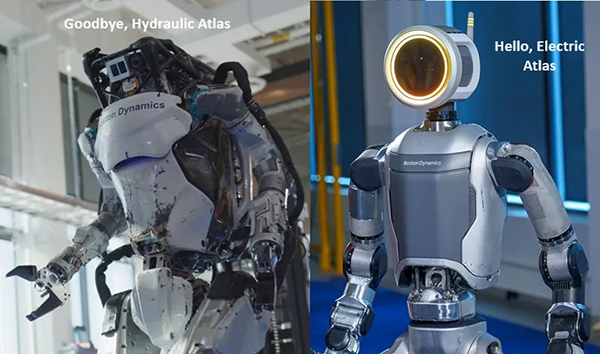
Certainly, an enormous extra boost for Electric Atlas is its collaboration with Google that integrates Google DeepMind’s Gemini Robotics foundation models (announced at CES2026). Built on Google’s large-scale, multi-modal Gemini AI—directly into the Electric Atlas’s hardware. With that collaboration, Electric Atlas has added “zero-shot adaptation” to its new physical world.
For 2026, the production batch of the commercial Electric Atlas is fully committed to internal pilots at Hyundai facilities and Google DeepMind research labs. Still to come, Hyundai will open its Robot Metaplant Application Center (RMAC) which will serve as a testing ground to gather real-world manufacturing data and train the robot’s AI on factory tasks.
Meanwhile, back at the ranch on the Saemangeum
Hyundai is actively transitioning from a traditional automobile manufacturer with a $288 million Robot Manufacturing Cluster, which will be Hyundai’s first domestic robot factory, designed to mass-produce wearable, industrial, and logistics robots while establishing a localized robotics parts hub Mobility Solution Provider.
Hyundai is also building out a $4 billion AI Data Center to power “physical AI” for autonomous driving and advanced robotics.
The Saemangeum Development and Investment Agency (SDIA) has moved the target completion date from 15 years to full completion by 2035.
Start of the mega-project, March2027.
Stay ahead of East Asian robotics: China, Korea & Japan 2026-2030