
What well might be
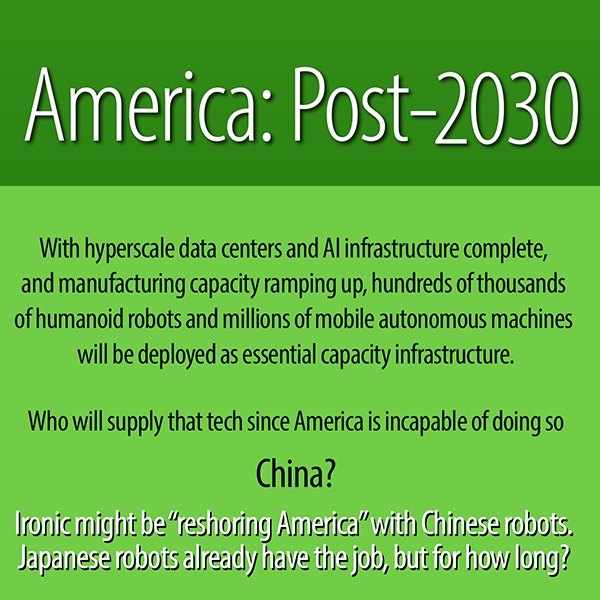
With hyperscale data centers and AI infrastructure complete (2030), and manufacturing capacity ramping up, forecasts are predicting for America that hundreds of thousands of humanoid robots and millions of mobile autonomous machines will be deployed as essential capacity infrastructure post-2030.
Who will supply that much tech since America is incapable of doing so itself? Japan, of course, is America’s incumbent for industrial robots, but lagging way behind in humanoids, and as a country, not even a player when it comes to AMRs and AGVs. In fact, Japan’s own factories are more and more importing Chinese robots. This changes everything!
America has a lot of soul searching to do in allowing for the demise of 50 native American robot manufacturers in the 1980s, apologizing to Congress with Competitive Position of U.S. Producers of Robotics in Domestic and World Markets (1983) by the United States International Trade Commission. Adept, the last American robotics company, was acquired by OMRON Corporation in October 2015 for approximately $200 million ($13.00 per share). America may come to rue the day it allowed such robotics potential to disappear.

Here’s a thought
What about China as robot supply master to America? A decade back, most people would have scoffed at such notion. Not any longer.
Will China take a page from Honda’s 1982 auto plant in Marysville, OH, which opened the floodgates to Japanese car makers, who now produce 3 million cars annually in America, and employ 108,000 American workers, and who take in an estimated annual salary of $83,000 per worker for a combined $9 billion payroll for Japan’s U.S.-based operations.
With Japan, and most everyone else lagging behind China’s humanoid ecosystem, China could be a first mover of made-in-America humanoids by Chinese manufacturers, in the process ducking any tariffs for offshore brands.
China could well build dual-purpose plants for both humanoids and EVs. Like Elon says about Tesla that it’s really a robot on four wheels, so is BYD. China would as well have first mover credentials for building AMRs and AGVs with machines from Geek+ or AgileX or Hai Robotics. Not to mention four topflight manufacturers of industrial robots and eight excellent cobot brands.
Plus, China now produces quality robot parts (although Japan is still the emperor of parts) like actuators, reducers, gear boxes, sensors, and batteries.
Japan, with a stranglehold on sales of its industrial robots in America, would be hard pressed to compete with mega-sized Chinese U.S.-based factories pumping out humanoids, industrial robots, cobots, AMRs and AGVs…and EVs. With such a varied lineup of robots and EVs, imagine the discounts China could dish out. Like selling fleets of EVs to Coca-Cola as well as all the humanoids, industrial robots, and cobots it could possibly use…for the low, low price of…
And some mega extras!
Imagine for a moment Chinese factories teaching millions of Americans the skills to build the machines that will power America’s future manufacturing and logistics…and maybe drive the family on holiday vacation in a Geely. Just ask Ford’s CEO Jim Farley what Chinese EV quality is like, after he returned from a visit to China, stunned at how far America’s carmakers have to go to compete.
Imagine as well, millions of Americans earning fair wages, plus maybe generous benefit plans, and maybe wonderful pensions courtesy of Estun USA, Unitree America, or UBTECH USA?
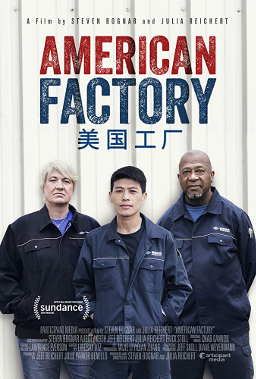
In microcosm, the Chinese robot takeover might look like the giant Chinese windshield and automotive glass maker Fuyao Glass America that acquired a shuttered 1.4 million-square-foot General Motors assembly plant in Moraine OH, and then spent $450 million rejiggering it for automotive glass. See the Netflix documentary that tells the story: American Factory.
Lastly, but probably not lastly as such drastic changes go, how favorably disposed about China and its people would these same Chinese-employed American workers be in the face of U.S. government bashing of things Chinese? Or in a favorable state of mind to buy other Chinese products sold in America, or to other Chinese firsts like cures for diabetes or even dental implants. How would such American thinking, while in a pro-China state of mind, impact voting booths across America?
In fact, for sheer people-to-people diplomacy and goodwill, might China’s robot factories in America be positive emissaries at uniting two nations that lots of folks are doing their damndest to keep apart?
Who knows, Americans may start flocking to China on family vacations as their children gobble up Mandarin in school.

What forecasters are writing
It should be well noted that scaling from tens of thousands of units to millions requires manufacturing capacity no country has yet built for this product class.
Yet the demand signals are structural, not cyclical. Labor shortages will worsen as demographics shift. Reshoring commitments are multi-decade. Warehouse throughput requirements grow with e-commerce penetration. And the AI infrastructure underpinning robot autonomy is maturing on the same exponential curve that transformed language models.
By 2030, America won’t get “hundreds of thousands” of humanoid robots, AMRs, AGVs, and cobots from a single place. It will come from a hybrid stack: scaled domestic and allied production, plus (if policy allows) large imports from China and other low-cost Asian suppliers.
China will almost certainly have the best pricing and the deepest production capacity; the U.S. and allies can lead in high-end AI, safety certification, and systems integration, but not in raw unit cost or volume.
Humanoids, AMRs & AGVs
Humanoid robots occupy a distinct category. Unlike traditional industrial arms bolted to factory floors, humanoids are designed to operate in environments built for people — navigating stairs, using human-scale tools, and performing tasks across mixed-use spaces without retrofitting the workplace.
Goldman Sachs projects the global humanoid market will reach $38 billion by 2035, with 1.4 million units shipped annually — a forecast revised sixfold from its original $6 billion estimate. At a 5–15% labor substitution rate in automotive and specialized operations, global demand could reach 1.1 million to 3.5 million units (Goldman Sachs). Current production costs range from $30,000 to $150,000 per unit, with Goldman Sachs reporting a 40% reduction in bill-of-materials assumptions and projections pointing toward $15,000–$20,000 as manufacturing scales (Fruition Group).
Morgan Stanley’s Global Humanoid TAM model forecasts a U.S. installed base of 8 million humanoids by 2040 and 63 million by 2050, with approximately 75% of U.S. occupations having some degree of “humanoidability” [yes, someone thinks that passes as a word] (Morgan Stanley). Globally, the bank envisions a very heady 1 billion humanoids by 2050, generating nearly $5 trillion in annual revenue — roughly double the combined revenue of the top 20 global automakers (Morgan Stanley).
For America specifically, a 1 to 2 million humanoid procurement scenario is conservative relative to Morgan Stanley’s longer-range U.S. installed-base estimates, a plausible midpoint in which humanoids penetrate industrial and commercial applications deeply but remain far from the saturation levels Morgan Stanley’s wowzy case envisions.
While humanoids capture headlines, mobile robots are already deployed at scale. AMRs and AGVs are the workhorses of warehouse logistics, factory material handling, port automation, and last-mile fulfillment. They require no human-like dexterity; they move things reliably, around the clock.
China as the volume engine
China’s advantages are structural:
- Cost: Producing a robot arm in the U.S. currently costs ~2.2× more than in China; battery packs can be ~24% more expensive in the U.S. That math doesn’t flip by 2030 without massive subsidies or redesign.
- Supply chain depth: China dominates downstream inputs (batteries, motors, gearboxes, controllers). Even if U.S. firms design the robot, many components and final assembly will route through China or Chinese-influenced supply chains.
- Price–capability tradeoff: One estimate puts China’s general-purpose robots at ~80% of the capability of top leaders but ~30% cheaper. Some Chinese humanoid startups already claim sub‑$30k mass-production targets.
A Strategic Imperative
America is approaching an inflection point where robot procurement transitions from discretionary capital expenditure to strategic infrastructure investment, as fundamental as semiconductor fabs, data centers, or power generation. The nation that builds its physical execution layer first will capture compounding advantages in manufacturing productivity, logistics efficiency, and labor cost resilience.