
NEXT-FIVE-YEARS600


2026-2030

Five Greatest Years
in the History of Robotics

Why the next 5 years?Unless you’ve been under a rock somewhere or went to live way, way off grid, there’s dramatic change rushing in on us that you better get ready to accept or reject; and once committed to either side, be prepared to join in or try to ride out your rejection. There’s no middle ground, no safe zone, and no wait-and-let’s-see mode available.
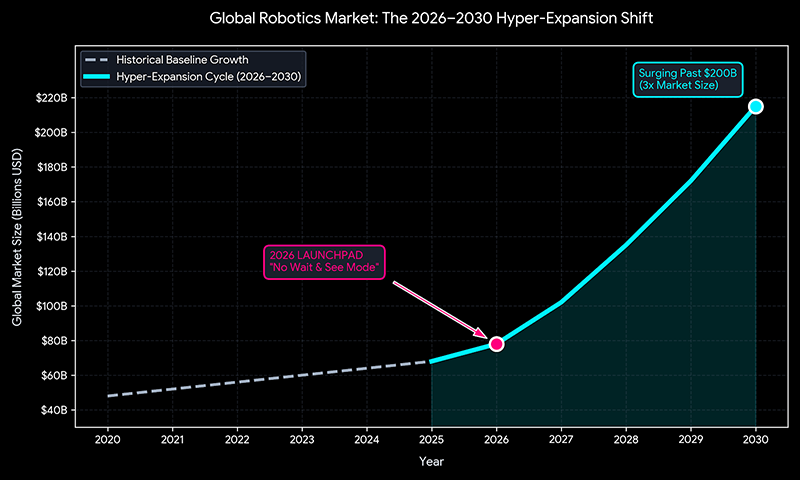
Leading institutions like Roland Berger and the International Federation of Robotics (IFR) view 2026 as the launchpad for an unprecedented five-year hyper-expansion cycle. Market indicators agree, projecting the global robotics sector will triple, surging past $200 billion by 2030.

Forecasters are shouting it and we rank and file are now feeling it as well that, here in 2026, we are standing on the edge of a monumental shift in human industry. It’s something that has been awkwardly pushing toward us for a while and then flashed itself into being in March of 2024, when code collapsed. Ever since, it has been building momentum that has only grown stronger. As all change seems to be when we first encounter it, it’s scary yet exciting. By 2026, it had settled in and was ready to go exponential on us all. And now it has! Get ready for the adventure of a lifetime compressed into a five-year run to the future.

Old robot ways
Since Unimate, some sixty years back, the promise of robotics has been held captive by rigid code, high deployment costs, and hyper-controlled environments. Robots were incredible at doing one thing millions of times in a sealed-off factory cell, but hand them a messy box, place them on uneven terrain, or introduce a human worker, and they collapsed into expensive paperweights. Well, maybe not as extreme as paperweights, but you get the drift. Like Hercules bursting his chains with a single great effort, robots ain’t robots no more.

Between 2026 and 2030, we will witness an unprecedented alignment of advanced AI, economic urgency, social demands, and hardware maturation. Robotics is transitioning from a discipline of purely mechanical engineering to an era of Physical Intelligence—where silicon brains meet versatile physical bodies.

This five-year window will not just be another incremental step; it will be remembered as the golden age of robotics. However, riding this wave requires more than just unchecked hype—it demands an understanding of where the real value lies and a sharp eye for the practical bottlenecks ahead.

The convergence: Why now?
Why is the 2026–2030 window the exact point of inflection? It boils down to three forces arriving at peak momentum simultaneously:

  • AI takes physical form: Generative AI and advanced machine learning models have broken out of software and entered physical space. Robots no longer require thousands of lines of hard-coded logic for every micro-movement; they can now perceive, reason, and adapt to messy, unpredictable environments in real time.
  • The ROI math finally works: Persistent global labor shortages, supply chain reshoring, and the need for operational resilience have transformed automation from a luxury into an absolute necessity. As component costs fall and software platforms standardize, the payback period for deploying automated systems has shrunk dramatically.
  • Breaking out of the factory cage: Robotics is expanding rapidly into warehouses, farms, hospitals, and construction sites. The tech is finally flexible enough to handle the chaotic reality of the outside world.

Heavy hitters: Sectors leading the charge
While the vision of a robot in every home is exciting, the real financial and operational revolution over the next five years is happening in key industrial and commercial sectors: Logistics & Warehousing, Advanced Manufacturing, Healthcare & Social Care, Agriculture, Defense & Security.

Beyond the hype: Humanoids vs. practical utility
If you look at social media or tech headlines, you might think humanoid robots will be serving coffee and walking dogs in every neighborhood by 2028. Humanoid form factors are undoubtedly captivating and hold immense long-term potential for environments designed strictly for human bodies.

However, looking at the 2026–2030 landscape with a realistic lens reveals a crucial distinction: humanoids will capture the headlines, but specialized systems will capture the value.

“The quiet workhorses of this era won’t always have two legs and a face. They will look like autonomous wheeled platforms, ultra-precise dexterous grippers, and nimble cobots working seamlessly side-by-side with human teams.”

Instead of replacing humans entirely, the most immediate economic boom is coming from cobots and specialized smart tools. These systems act as force multipliers for human workers, taking over the dull, dirty, and dangerous aspects of a job while leaving complex decision-making to people.

Wary of the pitfalls: Roadblocks ahead

Despite the immense momentum, this golden era will not be without serious speedbumps. Organizations and investors that jump in blind without addressing key operational risks will burn capital quickly.

Key risks to watch

  • Integration and software bottlenecks: Getting a shiny robot to work in a pristine demo video is easy; integrating it with decades-old enterprise resource planning (ERP) systems, legacy infrastructure, and complex workflows is brutally hard.
  • Customization trap: Scaling requires standardization. If every deployment requires bespoke engineering and custom code, margins evaporate and deployments stall out.
  • Cybersecurity and physical safety: As robots become autonomous and networked into critical supply chains, the threat surface expands. A compromised industrial fleet or a safety failure on a shared work floor could pause entire operations instantly.
  • Supply chain dependencies: The robotics hardware pipeline relies heavily on specialized actuators, rare-earth magnets, sensor suites, and advanced chips. Geopolitical frictions or regional supply disruptions could easily delay hardware scaling.

Winners of 2026–2030

As robotics crosses the threshold from “promising technology” into “essential economic infrastructure,” a clear divide will emerge. The biggest winners of this five-year run won’t necessarily be the companies building the flashy prototypes; they will be the pragmatic operators.

The organizations that win will be those that:

  1. Identify high-friction, high-repetition bottlenecks in their current workflows.
  2. Deploy field-tested, task-specific automation today rather than waiting for “perfect” future tech.
  3. Prioritize seamless human-robot collaboration, training their workforce to manage and work alongside smart machines.

The stretch from 2026 to 2030 will redefine how goods are moved, how fields are farmed, how surgeries are performed, and how products are built. The technology is ready, the market demand is undeniable, and the physical world is ready for an upgrade. Buckle up—it’s going to be a thrilling five years.