
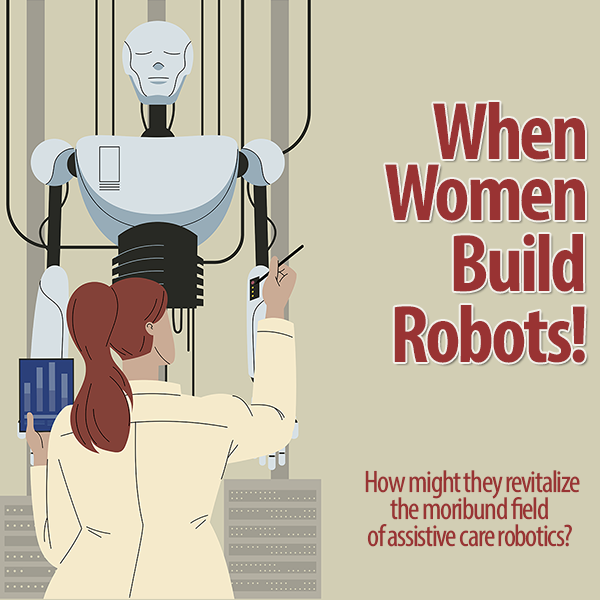

Making greater…
As Stephanie Murray writes in here recent article for The Atlantic, Whatever Happened to All Those Care Robots?: “Perhaps robots of the future will revolutionize caregiving as hoped. But the care robots we have now don’t even come close, and might even exacerbate the problems they’re meant to solve.”
Murray’s isn’t just a singular, lonely voice in the wind decrying the current state of care robots.
The National Institutes of Health: The Barriers of the Assistive Robotics Market—What Inhibits Health Innovation? “Many early-stage care robots have been abandoned or left unused because they failed to meet the practical, complex needs of daily living.” Inkwood Research: Disconnected Design Process “Engineering teams sometimes fail to communicate with the end-users (seniors and nurses), resulting in sophisticated devices that do not meet actual user need.” And finally, a Stanford Report: Exploring a Future with In-home Robot Caretakers, adds the usual cost prohibitive angle: “Advanced care robots can cost over $50,000 per unit, making them unaffordable for most individual households and many care facilities.”

Enter: the shock troops
If we want to remedy this sad situation in the near future, maybe we need to send in the shock troops: women!
Women are arguably the most compassionate, knowledgeable, and experienced, customer-facing caretakers worldwide. They excel at hospital care, healthcare, childcare, eldercare, and just about every kind of care imaginable, and have been since time in memoriam. Emotionally and intellectually, women have an obvious knack for care giving. These days a few of them (actually, too few) are building robots.
As the writer William Golding (Lord of the Flies) said of them: “I think women are foolish to pretend they are equal to men. They are far superior and always have been. Whatever you give a woman, she will make greater. If you give her sperm, she will give you a baby. If you give her a house, she will give you a home.”
Now, that’s a doer! Making greater is just what’s needed in the care-giving world of assistive robotics.
The making greater part of the Golding quote is intriguing and might have wild and wide implications when designing and building care robots, if we set loose Nature’s care-giving pros at designing and building them. That means any and all assistive robots, be they home robots, personal, healthcare, eldercare, or whatever other robots are intended to interface with taking care of humans face to face.
See also: When the Robot Burns the Toast
Kitchen robotics for elderly & handicapped

To date, other than hospital robot Moxi from (woman founded) Diligent Robotics, or the pediatric exoskeleton from (woman founded) Marsi Robotics, or Xiao Wu, the eldercare robot from Tencent’s X Lab, it’s difficult to name any successful carebots that have made any impact in the caregiving robotics industry.
Fixing the pipelines
The shock troops will need some serious assistance. Too few women in robotics needs a remedy; they represent a meagre 19% of professionals in the field, so obviously there’s a big hole to fill or maybe import China’s surplus of female engineers.
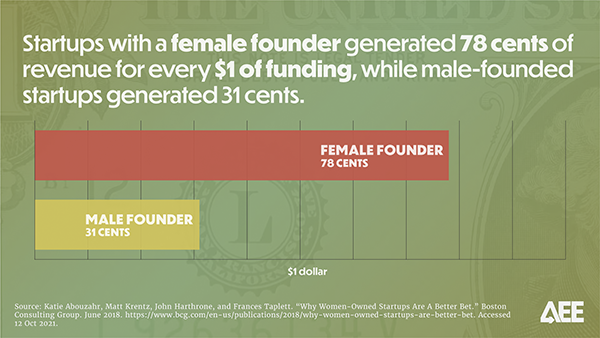
Also, money is very important. Female founders in startup robotics face grueling bias when it comes to VC or other types of (non-government) investments. “Female-founded startups, particularly in hardware-heavy sectors like robotics and AI, remain significantly overlooked, with all-women teams securing just 2.3 % of global venture capital (VC) funding in 2024–2025.” Actually, the 2% rate has held constant for a decade. Despite high-potential for innovation, these founders face intense bias, receiving less capital per deal compared to male counterparts.
Just for a sense of how big the investment pie is: In the first four months of 2026, over $26B was invested in robotics.
How women might perceive problems may be key
The field of robotics has historically been dominated by men, but the increasing involvement of women as designers and builders is reshaping the industry. This shift brings diverse perspectives that enhance innovation, particularly in the design of humanoid robots. Incorporating female expertise leads to more inclusive, empathetic, and user-friendly robotic solutions.
Advantages of female perspectives in humanoid robot design
In the field of human-robot interaction, there is a large debate on the role of sex differences in operators on the perception of robots. It is reported that females generally show more positive attitudes toward anthropomorphic robots (Lee, 2008; Abel et al., 2020, 2022).
“Males, on the other hand, have more positive attitudes toward classical robots (Cameron et al., 2018). Differences in the perception of robotic and humanoid movements were shown by Abel et al., 2020. They figured out that males seem to be more sensitive to the differences between robotic and anthropomorphic movements, whereas females showed no difference between them.
“However, females transferred more anthropomorphic features to robotic movements. Abel et al. (2020) investigated in a behavioral experiment the perception of anthropomorphic and robotic movements performed by a robot model and a digital human model in biological females and males.
Integrating female perspectives into humanoid robot design offers several benefits:
- Enhanced empathy and user-centric design: Women often bring empathetic insights that lead to robots designed with a deeper understanding of user needs. This approach ensures that robots are more intuitive and accessible to a broader audience.
- Diverse problem-solving approaches: Diverse teams, including women, introduce varied problem-solving strategies. This diversity fosters creativity and leads to innovative solutions that might not emerge in homogeneous groups.
- Addressing underrepresented needs: Female designers are more likely to consider the requirements of underrepresented populations, resulting in robots that cater to a wider range of users. This inclusivity enhances the overall utility and acceptance of robotic technologies.
- Improved aesthetics and functionality: Women offer unique perspectives on the aesthetics and functionality of robots, ensuring that form and function align with user expectations and cultural sensitivities.
Special insights from women robot designers
Women in robotics bring unique insights that enrich the field:
- Human-robot interaction: Female designers often emphasize the importance of seamless human-robot interaction, leading to robots that communicate more effectively and build trust with users.
- Ethical considerations: Women are more attuned to ethical implications, guiding the development of robots that respect privacy, promote well-being, and operate safely within societal norms.
- Interdisciplinary integration: Female designers often draw from various disciplines, such as psychology, sociology, and art, resulting in robots that are not only functional but also culturally and socially aware.
Case in point is how Diligent co-founders (2017) Andrea Thomaz and Vivian Chu put Moxi together (see above podcast This Is Robotics segment). They used parts already in the field and brought on a product designer, which garnered them a 2019 Time Magazine Best Inventions award. The highly-respected product designer Carla Diana worked on Moxi: Diana authored My Robot Gets Me: How Social Design Can Make New Products More Human (Harvard Business Review Press, 2021).
“With an arm to reach [from Kinova}, a gripper to pick up objects [from Robotiq] and a mobile base to move around [from Fetch Robotics], Moxi is able to complete duties end to end independently without being asked, relieving nurses of non-patient-facing tasks that studies show they otherwise spend up to 30% of their shifts on.”
Let’s let the shock troops loose
The involvement of women as designers and builders in robotics enriches the industry with diverse perspectives, leading to more empathetic, inclusive, and effective robotic solutions. By embracing female expertise, particularly in assistive robot design, the field can develop technologies that better serve all segments of society. Continued efforts to support and encourage women in robotics are vital for fostering innovation and addressing the complex challenges of the future.

Related report: INTELLIGENCE REPORT 2026:
ROBOTICS: CHINA, KOREA & jAPAN