
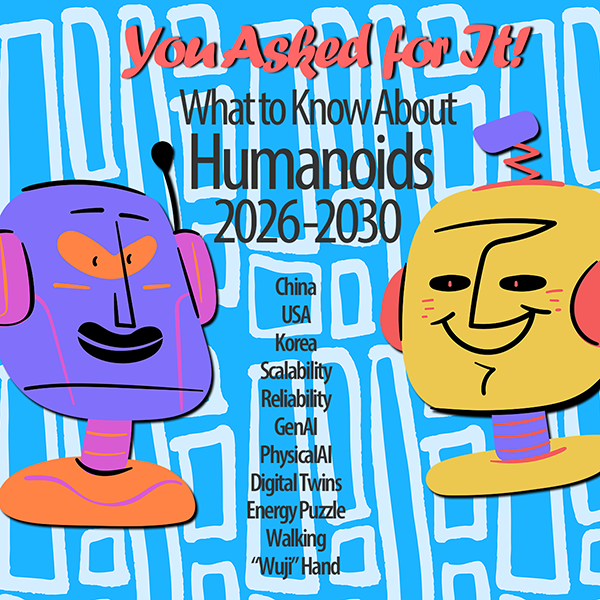
It’s a mighty big bet!
Global industry is betting tens of billions of dollars that the great humanoid ChatGPT moment has finally arrived. Has it arrived, or will it soon?
From the boardrooms of Silicon Valley to the state-sponsored innovation hubs of China, a consensus is building: Humanoid robots are poised to transition from laboratory marvels to real-world industrial assets. “There is a consensus in our industry that the ChatGPT moment for humanoid robots has arrived,” reasons Xiong Youjun, general manager at the Beijing Innovation Center for Humanoid Robotics, echoing a sentiment heard across the sector.
See related:“Artificial intelligence and robotics could catapult both fields to new heights.”
Many of you have asked us if all the hype is justified? Thanks for all of your email and the cyclone of interest these bi-pedal machines have stirred up in our readership. Your overriding question: Can these complex machines, which mimic human form and movement, truly scale to meet the ambitious production targets set by their creators and the exponential demands of the global logistics and manufacturing sectors?
The outlook for 2026 and beyond is a fascinating tapestry of breathtaking advances for technology. Hardly a news day goes by without headlines shouting out the newest breakthrough. Humanoids are on the rise seemingly everywhere and now the challenge to scale is pushing its way to the forefront.
The fast-paced, multi-front competition
The humanoid robotics landscape is not dominated by a single player or region. It has erupted into an amazingly multi-front competition, with distinct strengths and strategies defining the three key contenders: China, U.S. & Korea.
China: The pragmatic and prolific leader
China represents pragmatic, rapid-fire execution of nearly everything humanoids need to succeed. The country is not relying on a single flagship project but is unleashing a swarm of innovative companies—UBTech, Galaxy Robotics (Galbot), Agibot, Unitree, and Kepler Robotics—each demonstrating remarkable progress.
Interestingly, Chinese firms are not waiting for perfection; they are deploying now. Galbot claims to have already deployed almost 1,000 robots across various businesses. Their progress is visibly stunning: Agibot’s Lingxi X2 performing a perfect Webster flip, a gymnastics move of incredible complexity; Kepler’s “Bumblebee” K2 mastering a stable, straight-knee walk over uneven terrain using a novel hybrid actuator system; and Unitree offering a surprisingly capable humanoid, the R1, for a mere $16,000.
This velocity is underpinned by a formidable advantage: China’s mature and integrated supply chain for components like actuators and sensors. Startups like Wuji Tech are showcasing game-changing components, like a 20-degree-of-freedom robot hand with million-cycle durability, that Western counterparts struggle to match on cost or availability. With strong government support and a focus on solving immediate industrial problems, China is demonstrating a breakneck pace of innovation.
America: aspirational power-climber
America is leveraging its existing strengths in artificial intelligence and innovative ecosystems to compete in the emerging global humanoid robotics race. U.S. companies are distinguished by their systematic integration of cutting-edge artificial intelligence with robotics hardware. However, America’s humanoid companies, as recent news describes it, are pushing for national strategy, including a federal presence, to compete with China’s and Korea’s government support. Humanoids are a big undertaking that needs big money to win which only big government can support. But can any scale? American robotics companies prioritize scalable manufacturing from the design phase. Like Tesla has engineered its Generation 3 Optimus specifically for high-rate manufacturing, targeting production scaling to approximately 500,000 units annually by 2027.
Other U.S. players like Figure Robotics and Agility Robotics are taking a more measured, partnership-driven approach, focusing on specific use cases in logistics and warehousing.
Korea: An established incumbent
While the current buzz revolves around the U.S.-China duel, Korea remains a formidable force with established industrial giants like Hyundai-owned Boston Dynamics. Their Atlas robot has long been the gold standard for dynamic mobility, performing parkour routines that are still years ahead of the competition. Korea’s strength lies in deep, proven engineering excellence in mechanics and control systems. The question is whether these established players can adapt their cutting-edge, research-focused projects into cost-effective, scalable commercial products fast enough to compete with the new wave. Korean government initiatives have helped considerably, like the K-Humanoid Alliance.
The realistic outlook for 2026: scaling, but selectively
So, will 2026 be the year humanoids are everywhere? The answer is a nuanced one. Mass public adoption is still a distant dream. However, 2026 is set to be the year of selective scaling and paid pilots.
We will not see humanoids replacing complex, varied human jobs en masse. Instead, as Reyk Knuhtsen, analyst at SemiAnalysis, notes, “Humanoids won’t arrive all at once... but slowly enter more and more positions as their capabilities increase.” Their first homes will be in “low-stakes, failure-tolerant tasks.”
Think of controlled environments like:
- Automotive assembly lines: Performing repetitive tasks like moving parts between stations.
- Pharmaceutical logistics: Sorting and moving boxes in highly standardized warehouses under strict compliance rules.
- Agriculture and manufacturing: Handling repetitive, precise tasks in environments already designed for machinery.
The recent letter of intent from PharmAGRI for up to 10,000 Tesla Optimus units (from the third generation onward) is a perfect example of this trend. It’s a targeted application in a controlled, compliance-heavy industry where robots can generate audit trails and reduce reliance on specific labor pools.
The pros of humanoid readiness for 2026:
- Unprecedented AI advancement: GenAI has given robots the ability to understand natural language commands and learn on the job, moving beyond rigid, pre-programmed motions.
- Hardware maturity: Breakthroughs in actuation (like Kepler’s hybrid design), battery efficiency, and durable components (like the Wuji hand) are solving critical physical limitations.
- Proven, limited deployment: Companies like Galbot are already proving that useful work can be done today, generating real-world data that is invaluable for improvement.
- Massive investment: With over $5 billion in VC funding since 2024, the financial fuel for innovation is abundant.
The cons and hurdles for 2026:
- The reliability gap: Industrial customers demand 99.99% uptime. Today’s humanoids are not yet consistently this reliable. A factory losing tens of thousands of dollars per minute of downtime cannot afford to bet its line on fragile technology.
- The battery life bottleneck: Agility Robotics’ Digit needs a 90-minute battery for 30 minutes of work, maintaining a reserve for safety. Until energy density improves, operational efficiency remains a challenge.
- The safety Imperative: A falling robot is a dangerous projectile. New international safety standards (led by groups including Boston Dynamics) are essential but still in development. Initial deployments will require strict segregation from human workers.
- The cost equation: While prices are falling (Unitree’s R1 at $16,000), capable robots are still a major capital expense. The Return on Investment (ROI) must be crystal clear for widespread adoption.
The “Top 5 Keys” to unlocking the future
For humanoids to move beyond limited pilots to true scalability, the industry must focus on five critical technological accomplishments in the near future:
- Achieve “Five-Nines” (99.999%) Reliability:The hardware and software must become boringly predictable. They must operate for months without a critical failure that halts a production line. This is the single most important factor for gaining industrial trust.
- Solve the energy efficiency puzzle:Robots need to work longer shifts. This requires breakthroughs in battery technology, power management, and energy-efficient actuation to achieve a work-to-charge ratio that makes operational sense.
- Master force-sensitive dexterity:Picking up a lightbulb without crushing it and tightening a bolt to the exact correct torque are human skills robots must learn. Advanced force feedback in hands and wrists is non-negotiable for complex manipulation.
- Navigate unstructured environments autonomously:Robots must handle the unexpected—a spilled liquid on the floor, a misplaced pallet, a closed door—without remote human intervention. This requires a massive leap in on-board real-time perception and decision-making.
- Demonstrate cost-effective scalability:The promise is to replace human labor economically. The final hurdle is driving the unit cost down to a point where the ROI is undeniable for countless businesses, not just large pharmaceutical giants.
See related:Will the NVIDIA-Foxconn Alliance Win Humanoid Race?

The engine of advancement: Physical AI and digital twins
Two concepts will be absolutely pivotal in achieving these five keys: physical AI and digital twins.
Physical AI is the specialized branch of artificial intelligence that deals with perceiving and acting in the physical world. It’s what translates a language command (“Pick up that box”) into a series of complex, coordinated physical actions: identifying the box, navigating to it, adjusting gait for balance, calculating grip force, and lifting. OpenAI is ramping up efforts toward humanoids, recognizing that to achieve Artificial General Intelligence (AGI), AI must learn to interact with and understand the physical realm. As one roboticist noted, OpenAI and others need to move towards the physical world because they’ve “asymptoted on GPT-5” or “meaning the model has reached a plateau and is not the revolutionary leap some had hoped for, according to Wired.
Digital twins will be the primary training ground for this Physical AI. A digital twin is a ultra-realistic virtual replica of a robot, a factory floor, or even an entire warehouse. Within this simulated environment, thousands of robot “brains” can be trained simultaneously 24/7, experiencing millions of repetitions of tasks and encountering countless rare edge cases (slippery floors, falling objects) that would be too time-consuming, expensive, or dangerous to recreate in the real world.
Nvidia’s Isaac Sim platform is a leading tool in this space. This is how we will “AI our way” to reliability. By training in simulation and then transferring that learning to physical hardware (a process called sim-to-real transfer), companies can compress years of real-world testing into months. Kepler Robotics explicitly credited this approach for solving the immense challenge of getting their hybrid-actuator gait to work reliably outside the lab.
Financial projections: A meteoric rise on the horizon
Despite the hurdles, financial analysts project a meteoric rise for the industry, reflecting the immense potential of the technology. The base is still small, but the growth curve is steep.
- 2024: An estimated 2,500 units shipped globally.
- 2025: Projections from firms like Merrill Lynch forecast shipments to reach 18,000 units.
- 2026: Based on Tesla’s and others’ targets, the market could see shipments jump to between 50,000 and 100,000 units as early pilot programs expand.
- 2030: While specific decade-start projections are harder to pin down, the industry is aiming for an inflection point where annual shipments could easily reach the hundreds of thousands, moving beyond niche industrial applications into broader logistics and even early consumer-facing roles.
- Long-term (2050-2060): The truly staggering projections, like Morgan Stanley’s $5 trillion market and a global robot “population” of 1 billion units by 2050, underscore the transformative economic impact analysts believe is possible once the technology matures.
The final word: Revolution in the making
The path forward for humanoid robots is not the sudden, explosive arrival of ChatGPT. It will be a gradual, deliberate crawl out of the lab and into the corners of our industrial world. The year 2026 will not be the year of the robot overlord; it will be the year of the robot intern—learning, working under strict supervision, and slowly proving its worth.
The race between the U.S. and China adds a compelling layer of geopolitics to the technological drama. China currently leads in hardware innovation and deployment velocity, while the U.S. bets on a software-defined, scalable vision. The winner may not be a single country, but the global economy itself, as competition drives innovation and accelerates the arrival of a new automated workforce.
The obstacles are real—reliability, safety, and cost remain formidable gates to scale. But the advances are just as real. From performing Webster flips to walking steadily over grass, from signing multi-thousand-unit orders to developing million-cycle hands, the progress is undeniable. The humanoid robot is no longer a fantasy. It is a physical, tangible asset, and it is clocking in for work. The revolution may be starting slowly, but it is most certainly beginning.
There’s a wild ride ahead for technology, all which may well prove to be the ride of a lifetime…for all of us!