Quantum System Unsnarls AMR & AGV Warehouse Traffic Jams
the orchestration layer, the intelligence coordinating hundreds of machines moving simultaneously.”
Quantum traffic control
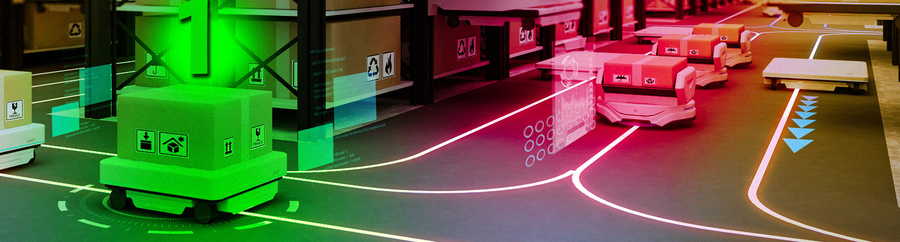
Although quantum computing is slow in coming to the aid of humanoid robots, it is actively being used in real-world applications like unsnarling traffic jams of AMRs and AGVs in warehouses and logistics hubs. In a famous case study, DENSO Corporation, a massive global automotive components manufacturer, used D-Wave Quantum’s hybrid system to do just that, successfully optimizing traffic jams among AMRs and AGVs.
As Rossinc Robotics reported: “Even inside an Amazon warehouse, a package can stop moving because two AMRs can’t agree who goes first. With over one million robots across 300 facilities, the real bottleneck isn’t the robot itself, it’s traffic coordination. At this scale, even a tiny logic gap can ripple across the system.”
In high-volume intralogistics, AMRs and AGVs are rarely the hard part. The real problem is the orchestration layer, the intelligence coordinating thousands of machines moving simultaneously. DENSO had encountered such a problem and D-Wave quantum hybrid computing was the remedy.
One warehouse aisle can look simple. But behind it sits one of the most complex traffic systems ever built.
“Robot congestion is one of those problems that can grow very quickly in an automated warehouse,” says Qinyang Guo, Operation & Robotic Maintenance Engineer for Shanghai’s Yanfeng Technology. “It may start with only one AMR stopping in an aisle because of a navigation fault, obstacle, communication issue, or unexpected system condition. But if that robot is positioned on a critical route, other robots may continue arriving behind it. Within a short time, one local fault can become a wider traffic problem.”
Surprisingly, such traffic jams are more common than one would think, writes James Kufner (remember him!?), now CTO at Symbotic, a group that should know best about warehouse traffic problems, reports: In large, heavy e-commerce fulfillment warehouses and logistics hubs,
“traffic jams are a major structural bottleneck rather than an occasional glitch.” Industry data indicates that as robot density increases to meet massive e-commerce demand, the primary limitation on warehouse throughput shifts from how fast an individual robot can travel to how frequently the fleet clogs shared lanes.
Enter “Quantum Annealing (QA)”
When dynamic traffic jams peak, overall robot utilization frequently drops by 10 to 20 percentage points, even though every robot appears to be “busy” standing in queues.
For an enlightening paper on how these traffic jams happen and their remedy, as well as the ongoing active use of quantum computing in logistics, see Quantum Computing Approaches to Autonomous Mobile Robots and Multi-Machine Systems.
“Quantum Annealing (QA),” says the report, “particularly with D-Wave systems, presents a transformative solution for optimizing task allocation in autonomous mobile robots (AMRs) and multi-machine systems. Traditional scheduling methods often struggle to efficiently solve NP-hard optimization problems, which results in inefficient resource utilization, increased idle time, and production delays.
“Quantum Annealing overcomes these limitations by formulating task scheduling as a Quadratic Unconstrained Binary Optimization (QUBO) problem. This allows quantum processors to explore multiple solution paths simultaneously, significantly speeding up the process of identifying near-optimal allocations.
“By leveraging the principle of quantum tunneling, QA is able to escape local minimum and find globally optimal or near-optimal solutions, ensuring balanced workload distribution among machines and minimizing production bottlenecks. In dynamic industrial environments, where real-time adjustments and adaptive scheduling are crucial, QA offers a significant advantage in continuously optimizing task assignments.”