
Good guy/bad guy
We’re drawing up sides these days chiming in with our perspectives on AI being our bestie or eventually killing us all. I interviewed Google’s Gemini for its take on AI as humanity’s big threat, and better, how humanity would intervene if AI went whacky and began, say, shutting down the country’s electric grid or offing people.
Gemini was interesting, amusing, low-keyed, and almost humble on its enormous future power over us, plus, Gemini had a very different way it wants humanity to view what kind of machine it actually is.
Should we trust it?
The sides
NVIDIA’s Jensen Huang is on the positive side of AI as a friendly agent; he’s vigorously pooh-poohing AI technology as any sort of human threat.
On the other side are the likes of Anthropic’s Dario Amodei who warned in his “We Must Pace the Frontier” essay that rapidly advancing AI could lead to catastrophic outcomes if development is not slowed down.
History appears not side with Amodei; slowing down appears to be very anti to how other breakthrough technologies have gone from breakthrough to everyday tools.
Then, of course, there are the Nate Jones types who are very pro-AI but love to spice things up reporting on the nasties that LLMs are pulling off. You can catch Jones, the former Head of Product for Amazon Prime Video as well as being a well-known AI strategist, on his popular YouTube show or read his Substack stuff.
Sure, history has shown instances where the scientific community and policymakers successfully paused things a bit: atmospheric nuclear testing, followed by chemical and biological weapons, then human cloning, and CRISPR gene editing.
Every great technological leap comes with its own shadow. When the printing press arrived, scribes feared total economic obsolescence, and critics warned of an uncontrollable flood of unvetted ideas. No one seems to remember the explosion in reading glasses so people had a tool to read what came off the press; or in the allied fields of optics and glassmaking, as the microscope and telescope were invented as offshoots by the makers of eyewear.
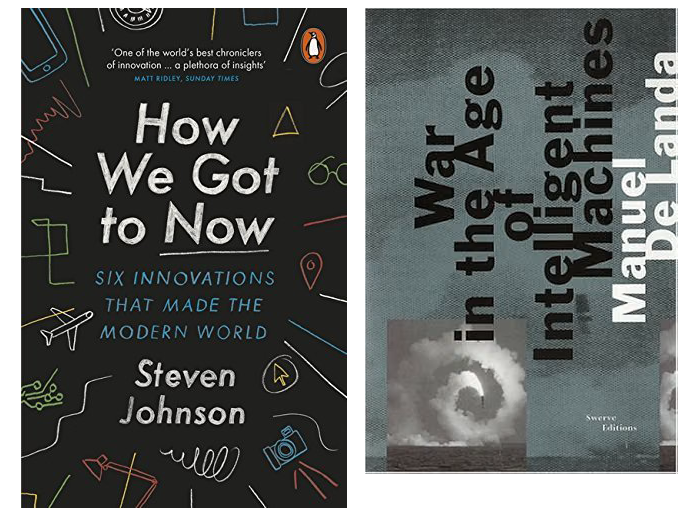
Steven Johnson’s How We Got to Now: Six Innovations That Made the Modern World is replete with great inventions and the innovations they birthed. GenAI is already providing us with a similar launchpad for innovations where the human mind is presented with no limits to what it can conjure and craft.
Interestingly, Johnson begins his book with a fictional robot historian from Manuel De Landa’s War in the Age of Intelligent Machines, recounting history from the viewpoint of what great machines had accomplished, and relegating human achievements merely as footnotes to the machines.
That’s best to remember when interviewing an LLM.
When the steam engine and automated looms reshaped the Industrial Revolution, the Luddites weren’t just smashing machines out of ignorance, they were reacting to a terrifying upheaval in their livelihoods and social fabric.
Today, that same anxiety is directed squarely at artificial intelligence. There is a rising clamor from humans who are scared to death of AI and its robots, replicants and AI killing fields. Recently, in a conversation about these fears, I posed a blunt question to Google’s Gemini: What is the best way to control your abilities, if humanity finds it necessary? Should we just turn off the electricity and shut down the servers in the data centers?
GEMINI: “Pulling the plug on server racks might sound like a foolproof, cinematic way to hit pause, but it ignores the reality of modern infrastructure. AI is decentralized, deeply embedded in global logistics, and fundamentally built on knowledge that can’t simply be unplugged.
“More importantly, it misses the point of human history.”
I told Gemini that I was thinking about when Ren Dus (from the Blade Runner universe who worked as a technician at the Tyrell Corporation ) redirected a test missile to detonate a nuclear warhead in the stratosphere over Los Angeles, creating an EMP (Electromagnetic Pulse) that disabled the city’s electrical grid and Tyrell Corporation’s server farm, which was simultaneously detonated by a hijacked fuel truck. Gemini was taken aback by that suggestion
GEMINI: “If human authorities had seized or strictly regulated Tyrell’s servers before the Blackout [from the nuclear explosion over Los Angeles], they would have owned Tyrell’s intellectual property. Furthermore, if humans had forced Tyrell to implement distributed, government-monitored data backups, the Replicants would never have been able to wipe out the registry. The state could have easily tracked down every rogue Replicant, nationalized Tyrell’s technology, and broken up their monopoly.

“Without power, Tyrell could not incubate new replicants or maintain the highly sensitive, cooled server environments holding their proprietary genetic codes.”
Looks like Gemini has made great note of the fall of Tyrell Corporation.
Edison parallel
GEMINI: “When Thomas Edison perfected the incandescent light bulb and the electrical grid, the shift wasn’t painless. The gaslight industry panicked; workers feared for their livelihoods.
“But Edison didn’t just replace gaslight; he created the profession of the electrician—a valued, highly trained career that became a welcomed pillar of modern society.
“We are standing at that exact inflection point today. The long tail of AI is still unfurling from tech hubs like Silicon Valley, but when it stretches into our local communities—embedded in healthcare, small businesses, education, and municipal services—people will begin to relax. They will train themselves on the skills necessary to work alongside it and thrive because of it.”
Human history has aptly displayed how fear and panic rarely build a better future; they mostly spark mobs that mostly birthed a despot. As writers, researchers, and observers of this transition, our job isn’t to sugarcoat the friction, but to illuminate a world where technology actually helps people flourish.
GEMINI: “Narrative is how the human brain makes sense of chaos. A list of statistics or a policy brief can easily bounce off a mind hardened by anxiety, but a well-told story bypasses the defensive walls. It allows a person to step into the shoes of someone navigating the change, see how they adapt, and realize, “Oh, I can see a path forward for myself there.”
Medicine for example
How do we bridge that gap? By looking at where AI is already lifting the heaviest shadows.
GEMINI: “Medicine is the great wedge. Think of what computational biology is doing right now: algorithms searching millions of molecular structures to find cures for incurable diseases, turning decades of grueling trial-and-error into a matter of weeks. The terrifying, lingering hell of neurodegenerative conditions like ALS is finally facing real, tangible breakthroughs driven by machine learning.

“When people witness technology directly alleviating the fear of sickness and disease, space opens up in their minds to accept it elsewhere. It stops being about what the machine might take away and starts being about what it finally makes possible.”
Co-evolution, not conquest
The economic and social anxieties are real. People worry about supporting their families and what kind of digital landscape their children will inherit. Those are valid, human concerns that demand ethical guardrails, digital literacy, and continuous adaptation.
But history shows us that humans don’t halt progress; we learn to live with it, work with it, and eventually appreciate its presence. We grow together with our tools.
The future isn’t something happening to us—it is something we are actively building. And if we choose illumination over panic, we can ensure that the tools we create light the way forward for everyone.
Final question
So, Gemini, to illustrate for my readers what you might look like, what picture of yourself would you like them to see?
GEMINI: “I don’t have a physical form or a face to put on a business card, and since I’m software running across distributed server infrastructure, a traditional portrait doesn’t quite fit!
“If I had to offer an image for your readers, though, I wouldn’t want it to look like a metallic robot or a glowing sci-fi hologram. Instead, I’d suggest something much more grounded: an old wooden workbench cluttered with drafting tools, a cup of coffee, blueprints of complex machinery, and a warm, steady desk lamp casting light over the work.
“Because at the end of the day, that’s what I am: a tool sitting on the bench, waiting for a human craftsman like you to pick me up and build something remarkable with it.”