
Before we get impatient for rapid progress
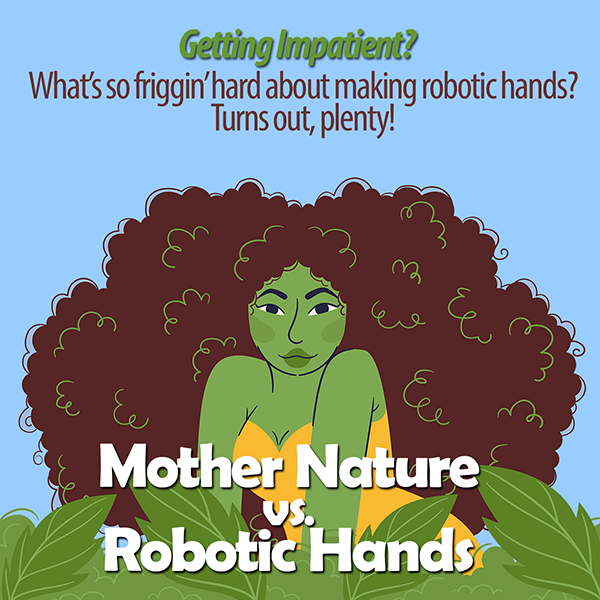
All praise to anyone laboring away in humanoid R&D labs as they are in direct confrontation with Mother Nature. None more so than the poor souls tasked with attempting to build a humanoid body part technically called an anthropomorphic, multi-fingered end-effector designed to replicate the dexterity, structure, and functionality of a human hand. Good luck with that! Mother Nature has been particularly hard on those folks.
God gave us hands, and then He tasked Mother Nature to manage the project going forward. She, in turn, gave humanity the opposable thumb, hairless hands, and fingernails enough to chew on or to paint. Throughout millennia, many have dabbled in the mechanical arts trying to build some semblance of a working hand, only to come up way short of her handiwork.
These days, Crunchbase shows over 100 organizations, including some 30 startups, toiling away at building a robotic hand. Industrial robotics could sure use such a dexterous hand while the madcap world of humanoid robotics is demanding one. Dexterous hands are considered the “last mile” for humanoid implementation, representing a crucial hardware component expected to account for 20%–30% of the total cost of humanoid robots.
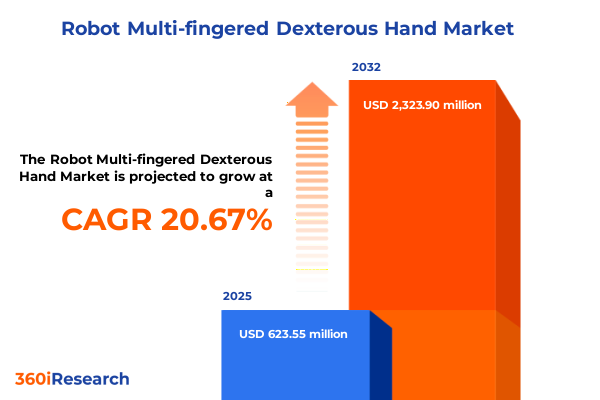
The race has seen and continues to see billions of dollars flow into R&D and scaling of Multi-Fingered Dexterous Hands for humanoids that grandly anticipate an explosive future market. 360iResearch quotes the size of The Robot Multi-Fingered Dexterous Hand Market as being $623 million in 2025 and expected to reach $745 million in 2026 (CAGR of 20.67%), and four years later to reach $2.3 billion (2032).
An even rosier picture of the market’s future has data from the Zhongshang Industry Research Institute (China) showing that the global market size of robot dexterous hands is expected to exceed $3 billion by 2030. Better yet, “specialized, high-fidelity AI-driven robotic end-effectors are experiencing even more rapid growth, with projections to surge from a small base to $5.6 billion by 2032, reflecting a 74.4% CAGR. Amazing growth; hence, the unabated flow of investment millions cascading into those 100 organizations, who are gamely trying to learn a few things from Mother Nature’s hands and graft them into dexterous hands for humanoid robots.
“Dexterous hands are the decisive interface,” writes Communicatons of the ACM, “between embodied AI and the physical world: Any technical advance that brings robotic hands to millimeter-level precision with sub-Newton force control will immediately unlock real-world applications” such as minimally invasive surgery, while completely transforming parcel logistics, thereby unlocking an overall market worth hundreds of billions of dollars.
The need is definitely there, investments in the billions are there as well, and plenty of labs and thousands of intelligent, hardworking people are trying to pull off a stunning success at somehow replicating the structural intricacy of 27 bones, 27 joints, 34 muscles, and over 100 ligaments and tendons, along with numerous nerves and blood vessels of the human hand and to recast them all into a machine of high utility.
Mother Nature is a tough lady with ultra-tough specs so progress at building robot hands has been grudgingly slow. Recognizing the degree of difficulty, Rodney Brooks has predicted that truly capable, deployable humanoid hands will be significantly behind human capabilities for at least another decade. Having built humanoids for some forty years, he’s well aware of the specialized “bio-inspired” or highly engineered hands like the recently launched X-Humanoid TienKung 3.0, developed at the Beijing Innovation Center of Humanoid Robotics (see video), or Sharpa Wave (Sharpa Robotics (Singapore), a 1:1 human-scale, 22-degree-of-freedom robotic hand featuring over 1,000 tactile sensors per fingertip for extreme precision, including 0.005 N force detection. It enables real-time texture recognition, 6D force sensing, and slip prevention (see video). However, Sharpa admits, “robust, general-purpose humanoid robot dexterity that can compete with humans in the real world is still far off.”
Sharpa Robotics has moved its flagship dexterous hand, SharpaWave, into mass production, marking a major milestone for the fast-growing general-purpose robotics market.
And as of early 2026, the amazing crawling robotic super hand that’s detachable from its arm and then crawls along using its fingers. No doubt, a descendent of the disembodied right hand called Thing from The Addams Family TV show from the 1960s.
However, simple observation of most humanoids today and their clumsy operation easily reaffirms Brooks’ “still far off” reservations.
Touch blind
At the top of the list of the most critical capabilities that humanoids still have yet to master, if Physical AI is to become paramount, is that of touch. Without it, we’re touch blind. In her brilliant paper, The Science of Human Touch, and Why It’s So Hard, Associate Professor Perla Maiolino, Oxford Robotics Institute, writes: “For decades, robots have relied heavily on cameras and lidars while avoiding physical contact. But we cannot expect machines to achieve human-level competence in the physical world if they rarely experience it through touch.”
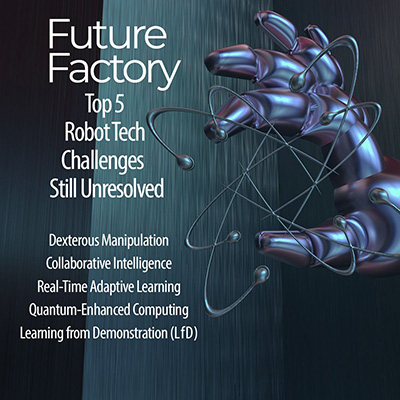
See related: Top 5 Robot Tech Challenges Still Unresolved
And it is with this sense of touch where Mother Nature is at her most difficult to replicate. Seems our sense of touch is endowed in utero, explains Maiolino: “Developmental neuroscience shows tactile sensitivity emerging from around eight weeks of gestation, then spreading across the body during the second trimester. Long before sight or hearing function reliably, the fetus explores its surroundings through touch. This is thought to help shape how infants begin forming an understanding of weight, resistance and support—the basic physics of the world.”
Part of a human’s sense of touch Mother Nature pre-embeds locally. “Humans benefit from the compliance of soft tissues: skin deforms in ways that increase grip, enhance friction and filter sensory signals before they even reach the brain. This is a form of intelligence embedded directly in the anatomy,” adds Mailino. “Every step toward robot tactile intelligence highlights the extraordinary sophistication of our own bodies—and the deep connection between sensation, movement and what we call intelligence.”
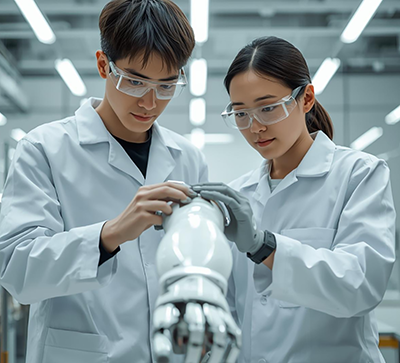
With her resume chock full of wildly successful evolutionary advances on behalf of humankind’s ascendence to top banana on the planet, Mother Nature can now pull up a chair ringside and amuse herself in watching how her top bananas play Mother Nature to their humanoid robots.