
STEPHEN KLEIN

GenAI’s
Lovable
Curmudgeon

klein-question600

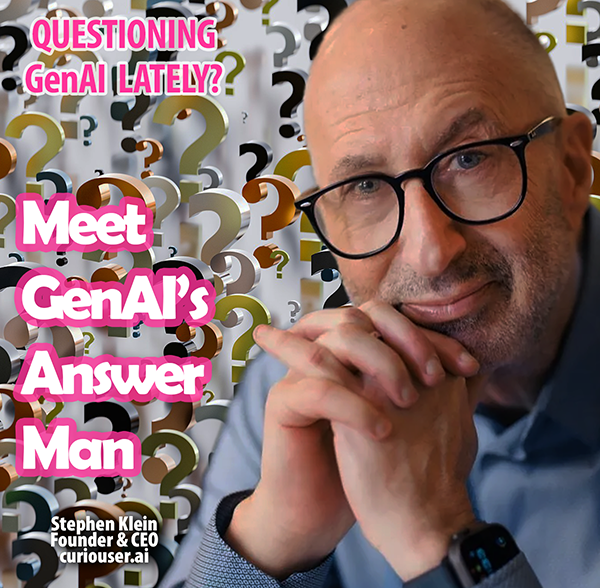
With a rapier-sharp wit and an interesting knack for the kill, Stephen Klein (his website and biz: Curiouser.AI) has been skewering the GenAI world and its builders, financiers, and corporate clients for months now, with sharp, pithy columns on LinkedIn, that get scads of comments both pro and con (generally pro). I’ve been collecting his columns for months now as they slide through my LinkedIn site. They are brilliantly insightful, erudite, head-noddingly commonsensical, and downright hilarious.

Curmudgeon in action!
A recent HubSpot magazine piece on Klein, Through the Looking Glass, profiles his “quest to make AI think before it speaks.” That’s a tall order, but he’s doing his level best to enlighten the rest of us as to what’s going on in this, the strangest of new technologies, where no one knows how it works.

He boldly goes where even curmudgeons usually fear to tread. Happy for us, he’s like that. He opens eyes and ears and a few brain cells. I can feel mine cheering him along. I’m kind of surprised that GenAI’s minions or VC investors haven’t yet put out a hit on him.

Who, other than Klein, would write titles like these below, and then back them up with tight research? Check these out (full articles included):

The $100 Billion Illusion: Who’s Actually Making Money in Generative AI?

Before the Internet, Our Minds Were in Balance

The Greatest Show on Earth Isn’t a Circus. It’s the Generative AI Theatrical Performance  Hype-as-a-Service (HaaS)

The $100 Billion Generative AI Doom Loop: Layoffs, Hallucinations, and the Snake That’s Eating Itself

How To Tell If Someone Is a Real Expert in GenAI:
A How-To Guide to Detect Hype-as-a-Service (HaaS)

The Answer Man Answering

I asked him how he digs up all his research.  “For research,” he explained, “I use Google, Grok, Claude, and GPT and triangulate the data (to find the inevitable mistakes). For brainstorming, I use my own AI Alice. I do my own writing.”

Self-admittedly, Klein is high on GenAI and thinks its potential will be of great benefit to one and all. In fact, he’s got his own, called Alice. That’s what makes him loveable: the curmudgeon is also a willing participant.  But he offers no quarter to a host of what he sees as GenAI wrongdoers, especially consultants.

He’s different, that’s for sure. Here are a few skewers. Enjoy

ABOUT STEPHEN KLEIN:
Stephen Klein: Co-Founder & CEO at Curiouser.AI, pioneering Reflective AI
Berkeley Instructor, sharing insights on AI, innovation, and deep thinking
Harvard MBA, bringing business strategy to AI-driven problem-solving
Passionate about applying AI to enhance human cognition & decision-making

"Maybe this is the moment when human creativity—messy, unpredictable, and irreplaceable—emerges as our most valuable competitive advantage." Stephen Klein

The $100 Billion Illusion: Who’s Actually Making Money in Generative AI?
Always follow the money.

I have never believed in anything more than the potential Generative AI holds for business and humanity.

But if we leave our fear at the door, and we see what’s actually going on, it is not that.

By 2026, the GenAI market is projected to surpass $100 billion. Every boardroom wants in. Every headline demands urgency.

And yet…

GenAI vendors like OpenAI and Anthropic lose billions annually with no path to profitability.

Hype-as-a-Service.

The Fortune 500 Monetization Mirage
Despite the spurious “everything is changing” false narrative, companies are struggling to show revenue gains from GenAI:

Google reported strong Q1 earnings in 2025, citing AI, but gains came from enhanced ads, not new products (Business Insider).

Microsoft claims a $3.70 ROI for every $1 spent on AI (MS Blog), but the study was commissioned by Microsoft, with no named Fortune 500 case studies.

Most “productivity gains” are anecdotal. Measured in hours saved, not dollars earned.

So far, the clearest result of GenAI in the enterprise?

Headcount reductions.

OpenAI lost ~$5 billion in 2024. Daily cost to run ChatGPT? $700,000/day (LessWrong, BI). (They have 5,000 people by the way)

Anthropic is burning through $2.7 billion in 2024 cash flow while hoping to generate $3.7B in revenue (The Information).

They’re subsidized by Big Tech, not because they’re profitable, but because they’re strategically useful.

Enter: The Consultant and Experts

Accenture: $900M in GenAI revenue in 2024. $3B in bookings.

McKinsey: No public revenue numbers, but one of the loudest drumbeats of “AI now or never.”

LinkedIn is flooded with “GPT-powered” webinars, $2,000 cohort programs, 100-slide decks promising to future-proof your strategy.

This isn’t innovation.
It’s monetized anxiety.

Are we using GenAI to solve real problems, or just optimizing slide decks?

I’m bullish on GenAI in the long run.
But the near-term business model isn’t intelligence.
It’s fear and influence and a false sense of “trust.”

Or so it seems.

Before the Internet, Our Minds Were in Balance
Before the Internet, our minds were in balance.
We built and created and analyzed and measured, left and right brain in harmony.

Then the Internet arrived.

It didn’t just change how we work, it changed what we value. Creative thinking scores in children have declined steadily since the 1990s, even as IQ scores continued to rise

And recent studies show that Internet searches can actually reduce creative diversity, leading groups to converge on the same familiar ideas instead of exploring the new .

Now comes AI.
Its impact on creativity is deeply ambivalent:

AI can boost creativity for lower-creativity individuals, improving novelty and quality by ~9%, but at the cost of reduced variety. Stories often become more alike .

In brainstorming, AI produces lots of ideas, but less divergence than humans naturally generate .

Despite hype, recent benchmarking found no significant creativity gains in large AI models over the past two years. Only ~0.28% of their responses matched the top 10% of human creative benchmarks .

So what now?
Engineers, coders, and data scientists may have the upper hand today. But how long can we go without makers, builders, and imaginative thinkers?

When everything is optimized but nothing original is created, what will we measure?

And if AI doesn’t truly create but only mimics, then who will build?

Maybe this is the moment when human creativity—messy, unpredictable, and irreplaceable—emerges as our most valuable competitive advantage.
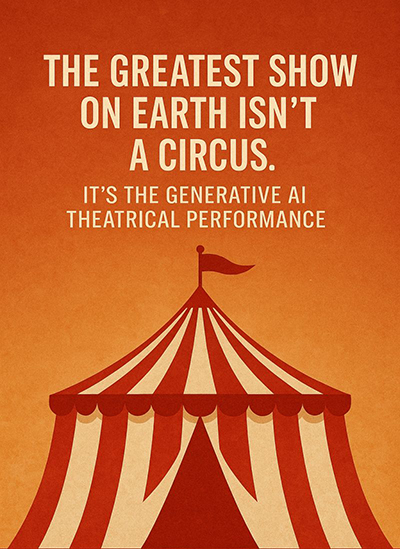
The Greatest Show on Earth Isn’t a Circus. It’s the Generative AI Theatrical Performance: We Are Participants In A Synthetic Reality

This isn’t a revolution
It’s a production
A circus

A high-budget, fear-fueled spectacle
designed to look like intelligence,
sound like inevitability
and sell the illusion of transformation.

Shakespeare said, “All the world’s a stage.”
He could’ve been talking about 2025.

Because what we’re witnessing isn’t just hype.

It’s Cognitive Theatre:

A scripted simulation of progress,
designed to captivate belief
and disarm critical thinking.

(Between us it’s also the most massive bubble in history)

And behind the curtain?

A deeper illusion I call Synthetic Reality
polished, immersive, and disconnected
from how real business value is created

The economics don’t work
OpenAI lost over $520M in 2022.¹
Its user costs exceed $40/year² while most pay under $20.
Anthropic raised $4B+³ but insiders cashed out at $80B valuations.⁴

The tech isn’t getting better. It’s getting brittle.
GPT-4 gave incorrect, but confident, medical answers in 52% of cases.⁵
OpenAI now warns: *“Don’t trust our agents with high-stakes tasks.”*⁶

Most enterprise pilots fail.
80–90% of GenAI initiatives in the Fortune 1000 never reach production.⁷
Strategy was replaced by spectacle.

The “job loss” story? Mostly theatre.
Layoffs are being rebranded as “AI transformation,” but the IMF confirms the disruption narrative is exaggerated.⁸
It’s not disruption, it’s convenience.

The real winners?

Investors and founders
who have already
made a killing
in the secondary markets
(They got their money out)

Consultants and Influencers
selling their services
They’re monetizing fear and urgency
delivering decks, not transformation

But here’s the good news:

When the curtain falls, the real work begins.

Because AI can still elevate.
But only if we stop treating it like IT infrastructure
and start leading with strategy, ethics, and imagination.

We will land in an amazing place
where people are valued,
companies compete on trust and creativity,
and AI is used to build and elevate, not dismantle and extract.

"Are we using GenAI to solve real problems, or just optimizing slide decks?"