
The three-legged stool
While demographic decline grips East Asia—with rapidly aging populations, shrinking workforces, and plummeting fertility rates—the region’s three economic powerhouses are responding with vastly different levels of urgency and competence to the GenAI revolution that is surging globally.
This technological gap comes at a particularly precarious moment. By 2050, one in three people in East Asia will be over 65, with Japan’s population expected to decline by 16 percent while senior citizens living alone will jump by 47 percent. China faces a projected decrease of 220 million working-age individuals between 2011 and 2050, while Korea grapples with fertility rates 59 percent below replacement levels (generally, around 2.1 children per woman). These demographic tsunamis demand immediate automation solutions—precisely where generative AI-powered robotics excels.
See related: China, Korea, & Japan:The New Pandemic
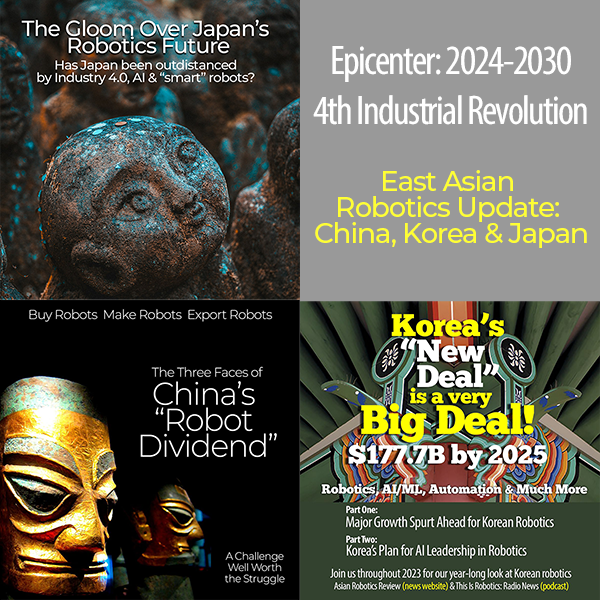
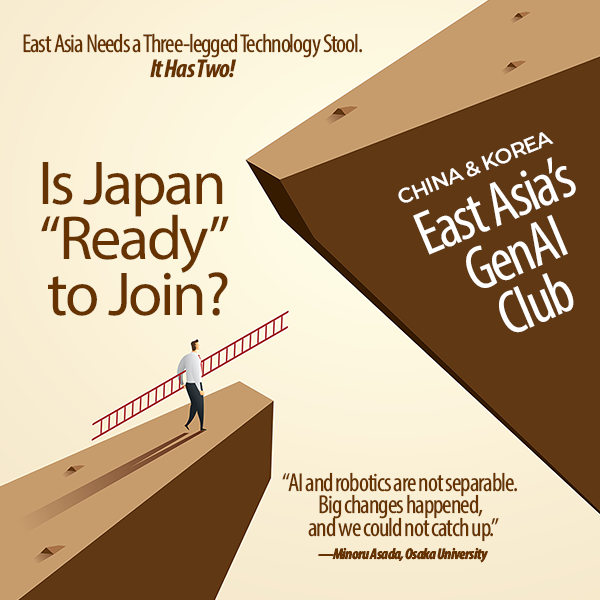
To their credit for risk-taking and dogged determination, China and Korea have emerged as formidable forces with the integration of GenAI and robotics. They form two sturdy legs of what should be East Asia’s three-legged technological stool. Japan, on the other hand, despite its storied history in robotics and automation, remains the laggard—struggling to secure its position as the essential third leg that could stabilize the entire region’s AI future. EDITOR’S NOTE: In 2024, Asian Robotics Review published a series of articles dealing with Japan’s struggles at integrating GenAI into its robotics industry. Our current article is a return to the same ground to re-examine and update where Japan stands today on the same issues.
The stark reality of Japan’s AI lag
The numbers paint a sobering picture of Japan’s position in the global AI landscape. While Japan ranks seventh worldwide for overall AI and robotics research according to the Nature Index, none of its research institutions crack the top 30 for AI and robotics based on data from 2015 to 2021. More troubling still, Japan is increasingly outperformed by its East Asian neighbors: Korea increased its AI and robotics research share by 1,138 percent between 2015 and 2021, while Japan managed only 397 percent growth over the same period.
The generative AI adoption statistics are equally stark. Only 26.7 percent of Japanese people reported using GenAI in fiscal 2024, compared to China’s commanding 81.2 percent and the United States’ 68.8 percent[5]. Among companies, just 49.7 percent of Japanese firms planned to use GenAI, while over 80 percent of Chinese and American companies aimed to adopt the technology. All, however, regardless of being East or West, have actually implemented GenAI far fewer times than their adoption “aims”. For example, although aiming for 80 percent, the actual U.S. implementations hover about 27 percent.
Perhaps most concerning is Japan’s projected shortage of 789,000 software engineers by 2030, as identified by the Ministry of Economy, Trade and Industry (METI). This talent deficit strikes at the heart of Japan’s GenAI ambitions, as Noriyuki Kojima, co-founder of Japanese startup Kotoba Technology, explains: “Japan’s trailing position in the field of GenAI largely stems from its comparative shortcomings in deep learning and extensive software development”.
Moonshots as remedies
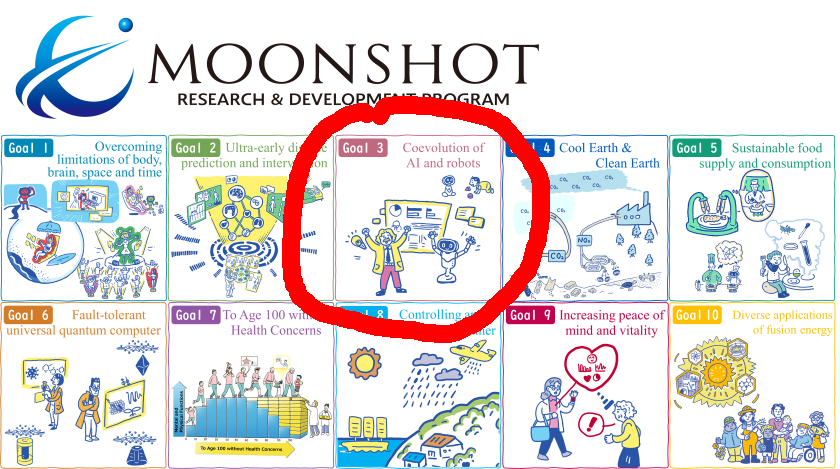
Japan’s remedies for AI-infused robotics arose grandly enough in January of 2020 with Japan’s Moonshot Goals (decided on by a Plenary session of the Council for Science, Technology and Innovation), the Ministry of Education, Culture, Sports, Science and Technology (“MEXT”), together with Japan Science and Technology Agency (“JST”) as a research and development promotion agency that would undertake research and development activities for achieving Moonshot #3: Expanding Frontiers Through Co-Evolution of AI and Robots. More specifically: “Realization of AI robots that autonomously learn, adapt to their environment, evolve themselves in intelligence and act alongside human beings, by 2050.” Then came COVID in 2020, and the world went into a tailspin.
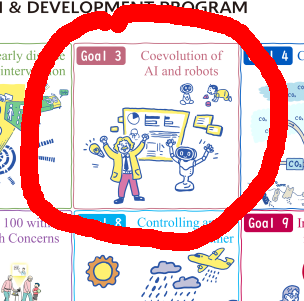
Post-COVID, China and Korea went on with integrating GenAI into robotics, as GenAI exploded into a global reality in 2023. What kept Japan from fulfilling Moonshot #3?
The global stakes couldn’t be higher at $1.3 trillion
The urgency of Japan’s situation becomes clearer when considering the scale of the GenAI opportunity. Bloomberg Intelligence projects the GenAI market will explode from $40 billion to $1.3 trillion by 2032. That’s an eye-watering compound annual growth rate of 42 percent!
According to WIPO, the World Intellectual Property Organization, China has positioned itself aggressively in the worldwide GenAI patent race. The top five inventor locations are China (38,210 inventions), U.S. (6,276 inventions), Korea (4,155 inventions), Japan (3,409), and India (1,350). China’s volume advantage in GenAI patents signals its determination to dominate the field.
Korea, meanwhile, has carved out its own competitive position. Despite ranking fifth globally in emerging technologies, Korea has demonstrated particular strength in AI talent development and government-backed initiatives like the “Framework Act on the Advancement of Artificial Intelligence and the Establishment of Trust”. Samsung Electronics filed 6,080 GenAI and other AI-related patent applications globally in 2024, demonstrating the country’s corporate commitment to AI leadership.
America’s helping hand: Multi-billion-dollar lifeline
Recognizing Japan’s strategic importance—and perhaps driven by geopolitical concerns about China’s regional expansion—American tech giants have mounted an unprecedented rescue mission. Microsoft announced a $2.9 billion investment over two years to expand AI and cloud infrastructure in Japan, while Amazon Web Services committed $15 billion in cloud infrastructure investment through 2027.
See related: Badly Needed GenAI & AI Robotics Help for Japan

The University of Washington and Carnegie Mellon University have partnered with Japanese institutions in a $110 million initiative backed by Amazon, NVIDIA, Microsoft, ARM, and SoftBank. Microsoft will train 3 million Japanese workers in AI skills over the next three years and has opened its first Microsoft Research Asia lab in Tokyo, focusing on robotics and AI integration.
These investments represent more than mere business expansion—they constitute a strategic intervention to prevent Japan from falling irreversibly behind in the AI race. As Microsoft President Brad Smith noted, “The competitiveness of every part of the Japanese economy will depend on the adoption of AI,” adding that AI is essential to “sustain productivity growth, even when a country has a declining population”.
Corporate champions: Japan’s potential AI powerhouses
Despite its challenges, Japan possesses formidable corporate assets that could drive its AI transformation. Toyota, through its research institute, has begun integrating large language models into human-robot interaction for elder care and service robots. The company’s partnership with Preferred Networks—Japan’s leading AI startup—demonstrates the potential for combining hardware expertise with cutting-edge AI capabilities.
SoftBank Robotics, despite past struggles commercializing robots like Pepper (decade old), possesses the AI investment experience and robotics platform to potentially reboot its humanoid offerings with GPT-4o-level conversational AI. FANUC, a dominant force in factory automation, could implement AI-driven predictive maintenance and develop self-programming robots.
Honda, with its legacy ASIMO (decades old) expertise, and Sony, with its entertainment robotics capabilities through Aibo (also decades old), both have the technical foundation to leap into AI-powered robotics. The key question is whether these companies can move with the speed and aggressiveness necessary to compete with American and Chinese rivals.
Although still wearing the crown of Emperor of All Robots, Japan’s industrial robot output is sliding south. According to the International Federation of Robotics, Japan produced 45 percent of the world’s industrial robots in 2013, but these days it’s hovering at 38 percent.
The innovation infrastructure challenge
Japan’s AI infrastructure limitations extend beyond talent shortages. The country’s AI systems market, valued at $7.56 billion in 2024 and projected to reach $26.80 billion by 2030, pales in comparison to China’s $25.1 billion and America’s $47.4 billion AI markets. This disparity reflects deeper structural challenges in Japan’s innovation ecosystem.
The AI robotics market in Japan is projected to reach $858.62 million in 2025, growing at a 26.45 percent CAGR to $3.51 billion by 2031. While significant, this growth trajectory may not be sufficient to close the gap with global leaders, particularly given the accelerating pace of AI development worldwide.
The path forward: Catching the “divine wind”…again!
Japan’s route to GenAI leadership requires immediate and coordinated action across multiple fronts. Consensus says the country must dramatically expand AI talent development, potentially through accelerated immigration policies and international recruitment. With over 1.44 million IT engineers currently, Japan needs to at least double this workforce while simultaneously upgrading skills to match GenAI requirements.
Japanese companies must also embrace the end-to-end neural network approach pioneered by firms like Tesla with its Optimus robot, rather than relying solely on traditional, hand-tuned robotics programming. This means integrating multimodal transformers that can receive camera and sensory inputs and output joint movements autonomously—a fundamental shift from Japan’s historically hardware-focused approach.
Japan’s government, like China and Korea have already put into place, must provide coordinated support comparable to China’s “Next Generation Artificial Intelligence Development Plan,” outlines an ambitious strategy to establish itself as the world leader in AI innovation and application by 2030. Similar is Korea’s Framework Act. Japan’s Society 5.0, which has seen some successes, particularly in driving innovation and investment in digital technologies, needs a China/Korea-type robust plan of action for AI-robotics.
Finally, Japanese firms need to forge strategic partnerships with global AI leaders while maintaining their technological sovereignty. Toyota’s collaboration with Boston Dynamics and Microsoft’s research lab establishment provide models for this approach.
The stakes of success and failure
The consequences of Japan’s AI choices extend far beyond corporate competitiveness. With East Asia collectively facing the world’s most dramatic demographic transformation, the region needs all three major economies firing on all technological cylinders. A Japan that successfully integrates GenAI with its robotics heritage could become the global leader in elder care automation, precision manufacturing, and human-robot collaboration. It’s a trio of GenAI robotics needs that has a multi-trillion dollar payoff on the near horizon.
Failure, however, could condemn Japan to technological dependency just as its demographic challenges peak. As the GenAI economy potentially reaches $7.9 trillion globally, Japan risks becoming a consumer nation rather than creator of the technologies that will define the next economic era, which historically Japan has always been in such an elite tech category.
The divine wind that once protected Japan from invasion now must come from artificial intelligence and robotics. With American partnership, corporate determination, and government resolve, Japan can still claim its position as East Asia’s essential third leg in the GenAI revolution. But the window for action narrows with each passing day, as China and Korea continue their relentless march toward AI supremacy. Japan’s choice is clear: join the GenAI club now, or risk permanent exclusion from the technologies that will reshape human civilization.
The three-legged stool of East Asian AI leadership awaits, remains incomplete—and unstable—until Japan fully commits to its GenAI transformation. The demographic tsunami is coming, and only the swift adoption of GenAI-powered automation can provide the solution East Asia desperately needs.
But, the question remains, is Japan ready to join?