
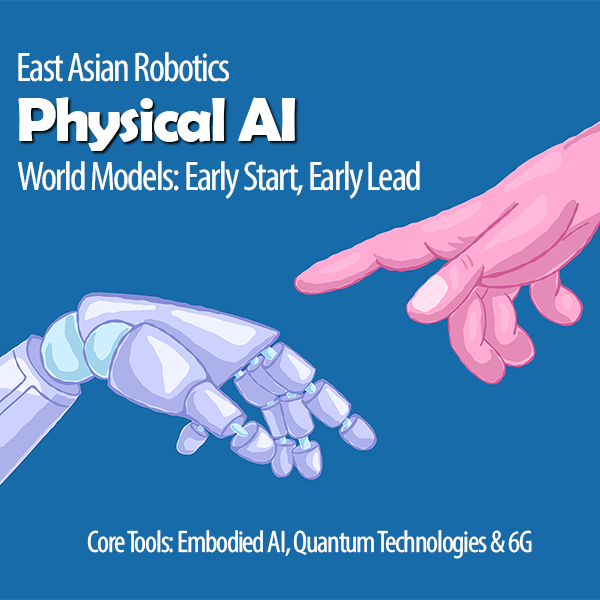
Understanding and acting upon the physical world
Yann LeCun has been telling us for years that the future of artificial intelligence lies not in generating text, but in understanding and acting upon the physical world.

The Turing Award winner and former Meta chief AI scientist recently launched Advanced Machine Intelligence Labs with a singular mission: building “world models” that can perceive, reason, and predict outcomes in real-world environments rather than merely processing language. His departure from Meta in late 2025 to pursue this vision signals a fundamental shift in AI development—and East Asia is already racing ahead to capitalize on it.
While Silicon Valley celebrated the generative AI revolution, East Asian manufacturers quietly positioned themselves at the forefront of Physical AI—embodied artificial intelligence systems that interact with the real world through robotics, autonomous vehicles, and intelligent manufacturing platforms. LeCun’s prediction that the “shelf life of the current LLM paradigm is fairly short, probably three to five years” is proving prophetic. As he noted at Davos 2025, we’re entering the “decade of robotics,” where advances in AI and physical systems converge to unlock applications that large language models simply cannot address.
East Asian advantage
East Asia’s dominance in Physical AI isn’t accidental—it’s structural. At December 2025’s International Robot Exhibition (IREX) in Tokyo, Physical AI emerged as the central theme, with record attendance of 156,110 visitors examining technologies that marry AI simulation with robotics and sensing capabilities. Japanese industrial giants FANUC and Yaskawa Electric, both collaborating with NVIDIA, showcased autonomous robots that modify motion paths in real-time to avoid humans and perform intelligent packing operations. The headline announcement came when SoftBank and Yaskawa Electric signed a memorandum of understanding to jointly develop Physical AI robots for offices, hospitals, and schools.
China’s supremacy in humanoid robotics provides the clearest evidence of East Asia’s Physical AI leadership. According to research from Omdia and Rest of World, Chinese companies controlled nearly 90% of the global humanoid robot market in 2025, with six of the highest-selling manufacturers based in China. Unitree, AgiBot, UBTECH, and other Chinese firms collectively produced over 10,000 humanoid robots in 2025—more than half of global output. By comparison, U.S. companies Figure AI, Agility Robotics, and Tesla each sold only around 150 units, with Tesla failing to meet its 5,000-unit production target.
This dominance extends beyond hardware volume. China has built an entire Physical AI ecosystem through government coordination that rivals lack. Following the March 2025 Government Work Report, which identified embodied AI alongside quantum technologies and 6G as core tools for “building the industries of the future,” Beijing mobilized resources at unprecedented scale. By July 2025, China had invested $3.4 billion in new robotics ventures—42% more than the United States and five times Europe’s total investment, putting themselves at the forefront of Physical AI—embodied artificial intelligence systems that interact with the real world through robotics, autonomous vehicles, and intelligent manufacturing platforms. LeCun’s prediction that the “shelf life of the current LLM paradigm is fairly short, probably three to five years” is proving prophetic. As he noted at Davos 2025, we’re entering the “decade of robotics,” where advances in AI and physical systems converge to unlock applications that large language models simply cannot address.
Infrastructure of intelligence
What makes Physical AI different from previous robotics waves is the integration of world models—AI systems that understand physical laws, causality, and temporal dynamics. This is precisely what LeCun advocates: systems that can predict how objects interact in space rather than simply executing pre-programmed tasks. East Asian companies are implementing this vision through massive data collection initiatives.
In China, hundreds of workers at government-established “data factories” wear VR headsets and exoskeletons to generate movement data for humanoid robots. These facilities in provinces like Hubei and Jiangsu employ “cyber-laborers” who perform mundane tasks—folding clothes, stacking blocks, ironing—hundreds of times daily. The standardized, large-scale data produced addresses the shortage of training information that has constrained Physical AI development globally. As one project spokesperson explained: “It’s like teaching children how to walk with lots of practice.”
Korea demonstrated its Physical AI capabilities at CES 2026, where Korean companies captured approximately 60% of CES Innovation Awards and eight of fifteen prizes in the robotics category. Samsung Electronics showcased its Custom AI refrigerator powered by Google’s Gemini, moving beyond simple ingredient recognition to personalized meal recommendations based on dietary patterns and health data. LG Electronics presented “affectionate intelligence” across ten appliances embedded with large language models responding to natural voice commands. Korean startups like GoLe Robotics and Navifra won recognition for delivery robots and vision-based AI systems that enable millimeter-level precision without traditional sensors.
Japan’s approach emphasizes human-robot collaboration in industrial settings. At IREX 2025, Kawasaki Heavy Industries’ humanoid robot Kaleido 9 attracted crowds with garden cleaning demonstrations, while collaborative robots from Yamaha Motor, Nachi-Fujikoshi, and Shibaura Machine showcased differentiation through compliance control, seven-axis manipulation, and automated assembly systems. The focus on safety and seamless operation reflects Japan’s manufacturing heritage adapted for the Physical AI era.
2026-2030 forecast
Market projections confirm East Asia’s trajectory toward Physical AI dominance. The global Physical AI market, valued at $5.13 billion in 2025, is projected to reach $83.64 billion by 2035, representing a compound annual growth rate of 34.4%.
Critically, Asia Pacific is expected to surpass all other regions in Physical AI adoption over the next decade, driven by rising labor costs, increased automation needs, and strong domestic manufacturing ecosystems.
China’s humanoid robot market alone is projected to explode from $377.56 million in 2024 to $10.26 billion by 2029. The Chinese government’s 15th Five-Year Plan (2026-2030) positions embodied intelligence as a new growth engine, with the National Development and Reform Commission announcing a$138 billion (see Bloomberg video below) fund for “hard tech” including robotics and AI.
The deployment timeline is accelerating. Chinese industry roadmaps envision three phases: foundation building (2025-2027) focused on shared datasets and open middleware; scaling (2028-2030) with deployment in factories, logistics, and elder-care pilots; and post-2030 generalization with mass-market humanoids. Industry leaders like Unitree’s CEO Wang Xingxing predict the sector’s “ChatGPT moment” will arrive when robots can complete 80% of tasks in unfamiliar settings simply by following voice or text instructions.
Marketplace transformation
Physical AI will fundamentally reshape the robotics marketplace through three mechanisms. First, it enables general-purpose robots that can learn multiple tasks rather than requiring task-specific programming for each application.
Vision-Language-Action (VLA) models showcased at the Conference on Neural Information Processing Systems in December 2025 demonstrated systems that see, understand language, and act in the physical world—capabilities that compress development cycles and expand addressable markets.
Second, Physical AI dramatically reduces deployment costs. Chinese manufacturers report production cost reductions of 20-30% annually as volumes scale. Unitree and similar companies have brought humanoid robot prices below $20,000, making them accessible for applications previously considered economically unviable. This cost compression mirrors the trajectory of electric vehicles, where Chinese manufacturers achieved global competitiveness through supply chain integration and manufacturing scale.
Third, Physical AI creates entirely new categories of robotic applications. Beyond traditional industrial automation, embodied intelligence enables service robots for healthcare, hospitality, retail, and home environments. The integration of world models allows robots to handle unstructured environments—precisely the scenarios where previous generations of automation failed.
East Asia’s Physical AI leadership positions the region to capture the majority of economic value as robotics transitions from specialized industrial tools to ubiquitous intelligent agents. With structural advantages in manufacturing, coordinated government support, and massive investments in data infrastructure, East Asian companies are building the foundation for the next phase of automation—one where machines understand and navigate the physical world as naturally as humans do.