


Help, not pity!
In the rush to converge robotics and AI together with humanoids, industrial and service robots, the UK, Canada, and Australia are being quickly left behind. Reports coming from those three countries, even from their own governments, are disturbing and shockingly sad. Let’s be clear: They will be “tech doomed” unless immediate action is taken to save them.
They don’t need pity. They need a helping hand. This Modest Proposal offers a way out of obscurity and stasis for their robotics/AI tech ambitions.
Before the UK, Canada, and Australia get devoured by the great tsunami of GenAI and Physical AI converging with robotics, America needs to gather together their rich veins of tech talent and create a singular and unified Fearsome Foursome of innovation and invention. The collective, four-way benefits would be a remarkable boon for each country while also elevating their status as important assets for the world’s future. The UK, Canada, and Australia would leap from being totally disenfranchised castaways to being highly-respected, powerhouses of robotics/AI excellence.
These four, Anglocentric countries would be natural allies at joining forces. Each of the countries speaks the same language, has the same traditions and common law infrastructures, and all tap their feet to the same rock music.
The brainiac talent pools resident in the UK, Canada, and Australia are more than considerable, but going forward from today, each is either teetering on being fallow forever or way underutilized. Their respective countries underspend on R&D via GDP: Australia 1.68%; Canada 1.7%, and the UK 2.6%. Recommended percentage: 3%. As of 2026, Israel and Korea lead the world in R&D intensity, investing over 5% of their GDP, while the US and China dominate in absolute spending, each surpassing $800 billion. With America at 4% annually and $800 billion, it could make for a super helping hand.
To help fund the venture, each country would ante up a percentage of their GDP currently allotted to R&D in robotics & AI, which is probably sub-nominal, but at least it’s an entry fee. Thereafter, each country would then share in commercialized robotics/AI in proportion to the percentage of their entry fees, as well as the percentages for joint ownership of their IP.
Projects for the group would come via U.S. federal contracts, which in 2024 were $755 billion, with the Department of Defense (DoD) accounting for roughly $445 billion, while civilian agencies spent roughly $310 billion. Given favored status in the bidding process might well prime the pump for the foursome’s R&D and commercialization efforts.
When fiscally stable and new companies are created by the foursome, each will be patriated to one or all of the participating nations by highest bid or by some other equitable co-commercialization arrangement.
Needless to say, the UK, Canada, and Australian trio would do well to join such a U.S.-led consortium. What’s the alternative?
Here’s why:
Status: UK
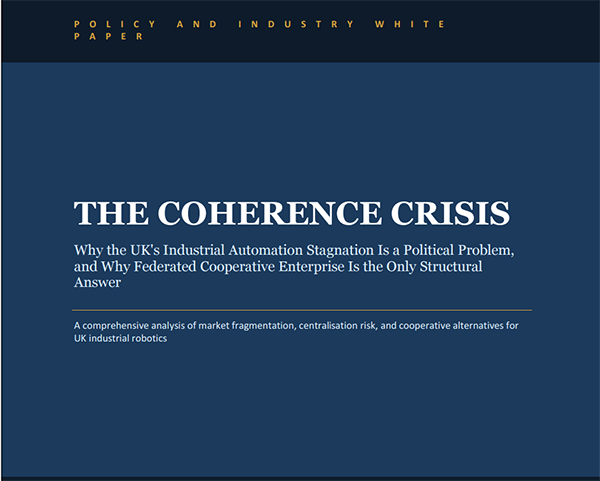
Out recently from the UK is THE COHERENCE CRISIS: Why the UK’s Industrial Automation Stagnation Is a Political Problem, and Why Federated Cooperative Enterprise Is the Only Structural Answer, which, once again, shows the UK’s hurting tech scene has no friends in Parliament, no friends on the Continent, and since BREXIT, bad juju seemingly everywhere.
The tech scene, filled with highly talented, competent, and eager individuals, is getting savaged…again! It’s not new, it happened at the end of WWII, when the National Research and Development Corporation (NRDC) had then Trade Minister David Wilson (later Prime Minister) dole out cash and loans to its newbie digital computing geniuses like Turing, Flowers, Newman, Kilburn, Wilkes, Williams, and the rest of the UK’s digital pioneers. Good old Dave doled out a paltry $4 million. The same crew that gave us Colossus were set out to dangle on a post-war vine of digital insignificance.
By comparison, America funded its digital bright boys to the tune of $3 billion (in 1945 dollars!).
No one offered aid or even took notice of the UK’s plight, except the Lyons Tea Company, which built the LEO computer (modeled on Cambridge’s EDSAC) and in 1951 used it for the first-ever computerized payroll. After that, there was never any follow up, and the UK’s fledgling digital future withered away.
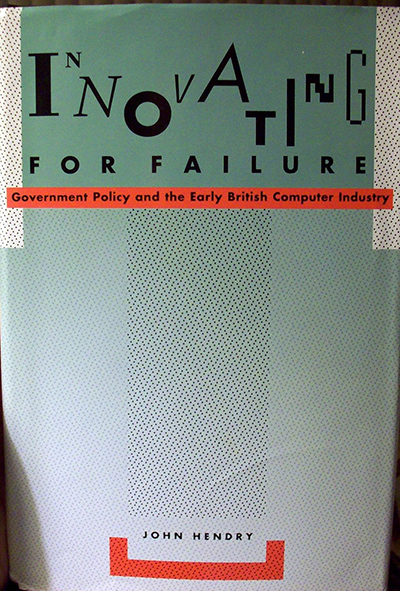
The UK didn’t recover until the 1970’s, at which time, the jig was up and any thought of the UK producing its own computer giant like an IBM or a Hewlett-Packard was totally and irrevocably lost. Read all about it from John Hendry’s Innovating for Failure: Government Policy and the Early British Computer Industry. For a more contemporary sense of very same angst, see: The Robot Revolution Will Turbo-Charge Growth. but Not in Britain.
Status: Australia
The poor Aussies are getting battered and are more than ripe for a new deal. Easy target CSIRO (Commonwealth Scientific and Industrial Research Organization) is the whipping boy once again.
Here’s what Universities Australia writes about the sad state of the country’s tech: “Universities Australia today sounded a warning that the announced restructure and workforce reduction at Australia’s national science agency, CSIRO, underscores the very real risks of chronic under-funding in the nation’s research system.

“‘When our national flagship science agency is forced to shed hundreds of jobs and narrow its research focus, it sends a clear message: Australia’s research engine is running short of fuel,’” said Chief Executive Officer Luke Sheehy.
“This isn’t just a CSIRO issue – it’s a warning light for the entire research ecosystem.
Australia is being outspent and outpaced by the world, Australia currently invests 1.69% of GDP into R&D – well below the OECD (Organization for Economic Co-operation and Development) recommended average of 3% and far behind innovation leaders like Korea and Israel.
“‘If we continue to under-invest, we will lose the talent, infrastructure and breakthroughs that drive jobs, national security and technological strength.’”
“’Research is not a cost, it is critical national infrastructure.’”
Approximately 300-350 research roles are targeted in the latest round of cuts (as of early 2026), following a reduction of over 800 positions over the previous 18 months.
Dude, that’s over 1100 researchers!
And sadly, it’s not the first time that CSIRO has taken a dooming budget cut. In 2012, Australia’s prowess in field robotics was world-dominating and its researchers in demand at most every tradeshow and conference worldwide.
In those days, Australian robotics and roboticists were everywhere and welcome.
Most all of it went into eclipse in 2014. The video below from a 2014 Australian news program says it all. Sadly morose, almost creepy, the news program depicts the descent of Australia’s once-proud tech scene into a shadow of its former self. The “budget repairs” of then-Prime Minister Tony Abbott—over $100 million less for tech—helped initiate the kill-off of Australian robotics as we knew it, beginning with the budget gutting of CSIRO. CSIRO is Australia’s premier R&D facility where, “we apply our research to inform policy, develop new industries and evolve existing sectors ensuring success into the future.” Not too much of that was wanted circa 2014; or so most everyone thought. It turned out to be a critical year in global robotics!
At the time, CSIRO chairman and former Australian of the Year, Simon McKeon, conceded the cuts had led to reduced staffing in virtually every part of the organization.
As McKeon put it: “Undeniably over this last year or so, we’ve also had to farewell scientists who are globally relevant – people who we would prefer not to have said goodbye to.”
Over 1400 jobs were lost. Researchers left Australia never to return.
Status: Canada

Canada’s 35 million citizens live continually in the shadow of America, which can become a hardship in and of itself.
Granted there’s super R&D and a reasonable amount of commercialization going on in Waterloo, Montreal, and Toronto, with a smattering in the Maritimes and British Columbia. But overall, Canada could use a jolt of energy partnering with the UK, Australia, and America.
The plight of the Canadians needing some serious help is more than evident in The State of Science, Technology, and Innovation in Canada 2025.
“A new study of Canada’s science, technology and innovation (STI) landscape warns that the country’s future is under threat as it falls further behind its international counterparts in the world of research and development.
“Calling Canada “an innovation laggard on multiple fronts,” the report released this week by the Council of Canadian Academies (CCA) says its analysis found ample evidence that the country needs to improve its research and development efforts — and ensure that the results are put to better use — if Canadians are going to preserve their place on the world stage.
The report states: “Our greatest weakness is an economy that consistently underuses and undervalues the capacity of Canadians to create prosperity for future generations.”
The CCA’s chair, Ilse Treurnicht, puts the country’s brain drain clearly in the crosshairs, saying, “We are losing highly qualified graduates to opportunities abroad, driven by wage disparities and limited research career prospects.”
“The commercialization of R&D in Canada remains a significant challenge, with a 2026 report from the Canadian Science Policy Centre (CSPC) highlighting a persistent “innovation gap” where top-tier research fails to translate into domestic economic value…and it consistently ranks low among OECD nations for innovation outputs, such as productivity growth, patenting, and technology adoption.”